Richard Ridout of Sherborne and Richard Ridout of North Wootton: the same man or not?

In the last blog I wrote about Thomas Ridout (1682-1760) son of Thomas and Margaret of North Wootton.  The Victorian genealogist Arthur Ridout recorded that the younger Thomas was baptised in 1694 and was the son of Thomas and Margaret of Sherborne and that the older Thomas was the son of John and Alice Ridout, born in Sherborne in 1666 and dying in 1694 in North Wootton. I don’t agree with Arthur on either count because, first of all, John and Alice’s son Thomas was, I believe, born in 1667 in Sherborne but was a cordwainer who married, had a family and died in London (see: Thomas Ridout of London). Secondly, I think this Ridout family, for reasons given below, lived exclusively in North Wootton and had done so for generations.  My theory is that Thomas Ridout of North Wootton was the son of a Richard and Jane – but Richard’s lineage is hard to pin down, not least of all because at one point there were two Richard Ridouts living at the same time who were possibly the same age!

The puzzle of the two Richards

William Ridowte of Hyle (1553-1620)’s son, Thomas Ridout of North Wootton (bp. 1574) and his second wife Edith PALMER baptised one son Richard on the 24th September 1618 and another on the 19th November 1620. Seeing two children of the same name usually (but not always) implies that the first died before the baptism of the second; I looked for the burial of an infant Richard between 1618 and 1620 in North Wootton or Sherborne (often the villagers were buried in the larger nearby town) but I failed to find anything. Nonetheless, the second Richard evidently survived at least thirty-four years as here is a small extract from the 1654 will of Walter Ridout, another son of Thomas Ridout:

“Item I give unto Edith Ridout the daughter of Richard my brother of Alweston [parish of Folke] four pounds…  Item I give unto Thomas Ridout the son of Richard Ridout of North Wootton that pte of wood which is between my brother and I at Lillington”.
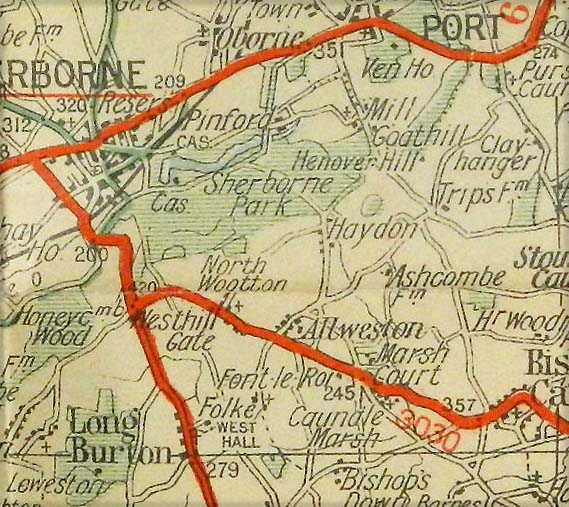
Old Dorset map showing Sherborne, North Wootton, Allweston and Folke.

Old Dorset map showing Sherborne, North Wootton, Allweston and Folke.

The wording indicates that ‘Richard of Folke’ was Walter’s brother but unfortunately the relationship between Walter and Richard of North Wootton, friend or family, was not elaborated. Lillington is a small village about five miles south of Sherborne, but nearer to North Wootton.

William Ridowte of Hyle made a bequest to his son Thomas’s son Richard in his will of 1620, written soon after the boy was born presumably, but he did not mention a second Richard. Arthur Ridout considered that Richard Ridout of Folke and Richard Ridout of North Wootton were one and the same man but I am sure that this is not true.  Here follows an explanation…

Richard Ridout of Folke

According to early records, Richard Ridout of Folke married Agnes KAINES; their first child, Edith, named by Walter in 1654, was baptised in Folke on the 18th April 1641. The couple had several children over the next few years, the last being Richard (bp. 17th July 1654). Richard Sr was mentioned a few times in manorial records, for example in the Protestation Returns of 1641 (in which a Richard Ridout of North Wootton was also listed), also in Chancery Proceedings, in the case of Bunter vs Downe dated the 11th April 1659, in which Richard was described as a 38 year old yeoman, and in a Court Leet in which Richard was listed as a tythingman (a spokesperson for the villagers of Folke).
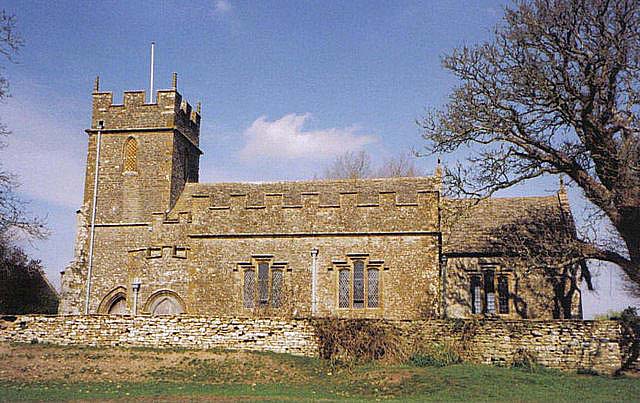
St Lawrence's church, Folke (© Chris Downer)

St Lawrence’s church, Folke (© Chris Downer)

Richard died and was buried in Folke churchyard on the 6th September 1669.  He left a will, the probate of which was granted in 1678 under the authority of the Dean of Sarum (a copy of the document is available in the Wiltshire archives). A yeoman, Richard appointed his wife ‘Agneta’ as his sole executrix and bequeathed his daughters Joan, Edith (CLARK), Constance, Hannah, Mary, Margaret, Jane, Elner and son Richard 1/- each. The remainder of his estate was left to Agnes; William Fauntleroy was named as overseer and witnessed the will along with Joan Ridout.

Agnes Ridout died and was buried in Folke on the 13th October 1689. In her will, dated 24th November 1686 and proved in 1690, she also mentioned her children: Margaret (who received a bed & an old chest), Mary WEST (a hat & 1/-), Edith Clarke, Joan COLLIER, Constance FEANER, Hannah NEWMAN & son Richard, who were given 1/- each. Agnes nominated her daughters Jane & Ellinor to be her executors and her ‘loving friends’ John Hammond & Richard Bedelcombe to be overseers. The witnesses to the will were John & Mary Hammond. So, as far as can be ascertained, Richard Ridout and Agnes Kaines married, had children, lived, died and were buried – in the village of Folke.

Richard Ridout of North Wootton

Three miles away in the village of North Wootton, another Richard Ridout also appeared in manorial records, for example, in the Chancery Proceedings (Dorset Suits No 138/8, Oke v Oke) dated the 29th December 1657 in which it was said that he was a 36 year old husbandman.  This Richard Ridout died on the 13th March 1661 and was buried six days later in Sherborne, but he was recorded as being ‘of North Wootton’; he died intestate but a document dated the 14th December 1662 shows that the joint administrators of his estate were widow Jeane (als Jane) Ridout, John Brett and Thomas Ridout.

So, Richard Ridout of North Wootton was married to Jane and was born, according to Chancery records, in ~1621 – the same time as Richard Ridout of Folke, but I know that this is a different man; Richard Ridout of North Wootton died in 1661, not 1669.  The document regarding administration of the latter’s estate includes an inventory which was compiled by John Brett senior and junior and a Thomas Ridout of North Wootten on the 4th July 1662:

                                              £    s    d
His wearing apparel	                     03	   00	00
five oxen			             24	   00	00
brown bull and heifers		             15	   00	00
five yearlings			             05	   00	00
two horses			             05	   00	00
five ewes and lambes and four other sheepe   03	   02	00
one pigge				     00	   10	00
eleven hens and one cocke		     00	   05	00
twelve bushells of wheate and …		     18	   00	00
twenty bushells of dates		     02	   00	00
three bushells of pease			     00	   12	00
two sides of bacon			     01	   00	00
for corn that was not threshed		     01	   13	04
for three brasse potts			     00	   15	00
three brass pans, three kittles, 
and two skillets		             02	   00	00
14 pewter dishes, one candlestick 
and one salte		                     01	   00	00
two featherbeds and two down beds	     01	   15	00
4 bedsteads and the cloathes 
belongin to fower beds		             02	   04	00
two table boards and 6 joynt stooles	     01	   00	00
four barrels				     00	   08	00
fower trendles and … other timber vessels    00	   13	04
two cubardes and two iron …		     00	   06	00
two table clothes and sixe napkins	     00	   06	00
two yoakes and one chain … (illegible)	     05	   00	00
(illegible)				     00	   13	00
for lumber				     00	   05	00

Signed by John Brett, John Brett and Thomas Ridout (who 
made his mark ‘R’)

The 1677 Sherborne Manor Survey shows in the homage of North Wootton a copyholder Jane Ridout, a widow aged 63 years (b. ~1614) and her sons Thomas (aged 23, b. ~1654) and John (aged 21 years, b. ~1656). The property in question was a ‘tenement with the appurtenances’; the acreage comprised 24 acres of pasture land, 13 of arable and 6 of meadow (total 43 acres) plus a yard. The annual rent was 10s 9d, with a yearly value of £15 and two capons at Easter. I searched for the baptisms of the two men mentioned in the 1677 survey, Jane’s sons Thomas and John. One possible baptism was that of John, on the 8th April 1655 in Sherborne to Richard Ridout.

In the 1709 Manor Survey of Sherborne, in the homage of North Wootton, is shown a copyhold tenement with appurtenances and a yard plus 24 acres of pasture, 6¼ of meadow and 13 of arable land (43¼ acres) with an annual rent of 10s 9d and two capons at Easter. Clearly, this is identical to the tenement described in 1677. The ‘lives’ are Thomas Ridout (55, b. ~1654), John Ridout his brother (53, b. ~1656) and ‘John Ridout his grandson’. The years of birth for the two men are identical to those in 1677 and hence these two ‘lives’ remained unchanged for over thirty years but, in the interim, Thomas had become not just a father but a grandfather, indicating that one of his children had a son John – the wording does not make it clear who was the boy’s father.

In 1717, according to the Sherborne Rentals, Thomas Ridout agreed to ‘add one life in reversion of two other lives’ for a leasehold tenement in North Wootton and in 1725, ‘Thomas Ridout Senior agreed to add the life of John Ridout, nephew of the said Thomas in reversion of him, the said Thomas and John his brother’ for a fine (fee) of £30 on his copyhold tenement’.  At this point, Thomas would have been seventy-one and his brother John two years younger. The ‘nephew John’ implies that Thomas’s brother John (or indeed another brother if there was one) had married and had a son John before 1725.

I found burials in the Sherborne registers for both Thomas and his wife Margaret, but not John.  Thomas was buried on the 28th June 1727 ‘of North Wootton’ and Margaret two years later on the 22nd May 1729, also in Sherborne ‘widow of North Wootton’. Interestingly, there is an entry in the North Wootton registers showing that a (?this) Thomas Ridout was the churchwarden in 1682 and maybe it was he that corrected the earlier parish register entries relating to Thomas Ridout (b. 1574) by adding Thomas’s wife’s name ‘Edith’ retrospectively:

Richard Ridout's baptism in North Wootton, 1620.

Richard Ridout’s baptism in North Wootton, 1620.

In 1735, Thomas Ridout ‘agreed to purchase by Copy of Court Roll, the Life of James Ridout his son in reversion of John Ridout his Uncle (now aged seventy-nine or possibly recently deceased) and John Ridout another son of the said Thomas Ridout’ for £35.  Finally, in 1756 Thomas ‘added a life and exchanged one’ but with no details of individuals. Further alterations to the same copyhold lease of North Wootton were made through the years by ‘Mr John Ridout’ and, in 1735, it was held by ‘He, Jno Ridout son of Thos and Saml Ridout, two sons of Thos Ridout.’ Once more the land comprised 43¼ acres with annual value of £15 and rent of 10s 9d and two capons at Easter. Thomas Ridout held two leasehold tenancies in North Wootton and one of the lives was ‘Susannah, his wife’.

From these surveys and from parish records, where available, it was possible to construct a tree:
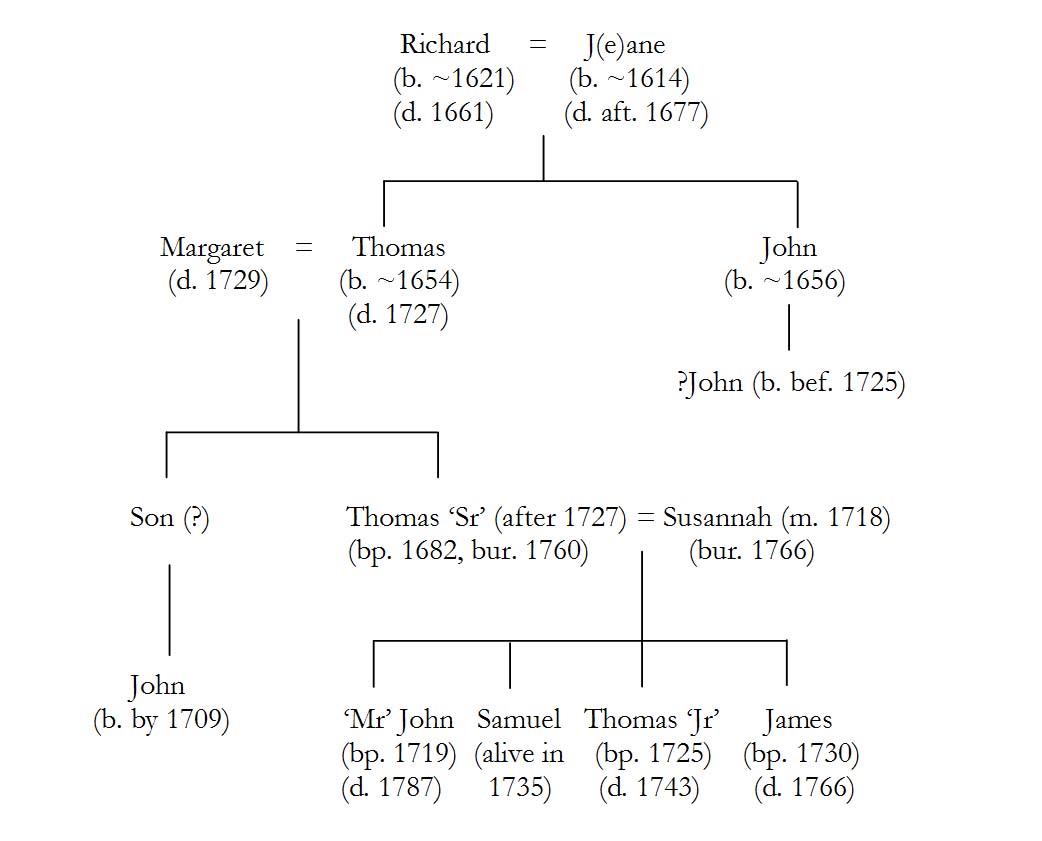
tree

It can be seen, from the tree that this is the family to which I referred in the last blog, ‘The Ridouts of North Wootton’ but that these manor records reveal three new individuals: John (b. ~1656) Thomas’s brother, an unidentified son of Thomas & Margaret and Samuel, a son of Thomas Ridout and Susannah Porter.

Tracing the North Wootton copyhold forward in time was intriguing but I also wondered how far back this property had been occupied by Ridouts. In the 1614 Manor Survey, in North Wootton, a copyhold tenancy is described:

“Thomas Ridowte holdeth bt Copie bearinge date the xj th daye of Aprill in the xxxix yeare of [our] late Quene Elizabeth by the grante of Sir Walter Ralegh, one tenemente & a yardelande conteininge a dwelling a barne orcharde garden & backside & a Close of pasture adjoininge conteininge iij acres, ij acres of meadow being in the moore, Close of pasture called Brailande conteining xij acres, j close of pasture called Quyntine conteining j acre & half, one close of pasture lande called Strowde conteining vij acres And in the common field in Parkfield iij acres In the Eastfield iij acres & half And in the southfield vj acres all arable lande, w[i]th comon for xvj beaste && xl sheepe in the comon field Rente”

Translated, Thomas Ridout held a copyright tenancy, dated 15th April 1596 by a grant of Sir Walter Raleigh. The tenement comprised a dwelling house, a yard and land (5 acres meadow, 27 acres of pasture and 6 acres of arable land, total 38 acres).  Amazingly, although more than sixty years earlier than the 1677 survey, the rent and annual value were identical and would remain so as late as 1748, when John Ridout ‘son of Thomas’ was still the copyholder. In 1748, the tenement was again described in detail : 3 Closes called ‘Bralaindes’ (16 acres), 1 Close called ‘Holk Stile’ (1 acre), 1 Close called ‘Quintons Mead’ (¾ acre), ‘Cross Field’ (3 acres), Orchard (1½ acres), Moor Meadow (3 acres), three pastures ‘Strouds’ (12 acres) and ‘Taylors Close’ (¾ acre), totalling 38 acres with the same rent of 10s 9d, largely unchanged from 134 years earlier!

So, a man called Thomas Ridout who was, presumably, an adult in 1614 (if not 1596) held the copyhold tenancy of a farm or smallholding in North Wootton which, at some point in the intervening sixty-three years, passed to Jane Ridout, Richard’s widow and her two sons and then to the various descendants of Thomas and Margaret. Perhaps the original tenant was William Ridowte and Agnetha Barnard’s son Thomas (b. 1574) and maybe he passed the tenancy to Richard, and thence to Richard’s son Thomas and his descendants. This Thomas had probably moved to North Wootton from Sherborne at some point between the baptism of his first child, Mary (bp. 1598 in Sherborne) and that of his second, William (bp. 1599 in N. Wootton)  But, is it really likely that Thomas and Edith Palmer named two sons Richard and that both survived into adulthood? Whilst there are precedents to this practice it bothers me that, in 1654, Walter Ridout didn’t identify Thomas, son of Richard Ridout of North Wootton as one of his nephews, albeit he left the boy some land, indicating a probable relationship. Equally William Ridowte didn’t name two Richards in his 1620 will, only one, being the ‘son of my son Thomas’ whereas both should have been alive if this theory was true. These details make me wonder if perhaps, like the Richards, there were also two Thomas Ridouts living in North Wootton at one time! What I do know is that one Thomas appears not to have been able to write his name. I wonder if William Ridowte’s son Thomas was literate?

It is unfortunate that the parish records for North Wootton are very sparse; some years have no entries at all and this is true of the period 1650-1659 when Richard and Jane may have married and when both Richard’s sons Thomas and John might have been baptised (although perhaps it was the correct John who was baptised in Sherborne in 1655). This mystery may remain unsolved, however unsatisfactory and frustrating.
Posted in General | Tagged , , , , , , | 21 Comments

The Ridouts of North Wootton

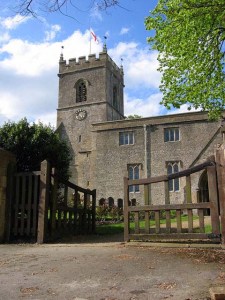
St Mary's church at North Wootton.  © Copyright Neil Hanson and licensed for reuse under this Creative Commons Licence

St Mary’s church at North Wootton.
© Copyright Neil Hanson and licensed for reuse under Creative Commons Licence

Thomas Ridout was baptised in North Wootton on the 13st February 1682, son of ‘Thomas and Margrett’. On the 29th March 1718, in Sherborne Abbey, Thomas married Susannah daughter of ‘John Porter of Compton’ (she was bp. 18th March 1693 in Nether Compton, a village three miles west of Sherborne). I did speculate as to whether John Porter could possibly be the brother of Elizabeth Porter, who married John Ridout of Nethercombe, but I can find no evidence for or against that hypothesis!

One useful way to discover something of an individual is by looking at his or her will. Both Thomas and Susannah wrote quite detailed wills – first an abridged version of Thomas’s will, dated the 14th April 1758:

“In the Name of God Amen I Thomas Ridout of North Wootton in the County of Dorset yeoman being weak but of a sound and disposing mind, memory and understanding do make this my last Will and Testament in manner following. Whereas I have a Mortgage on George Hockey’s estate lying in the Parish of Mudford in the County of Somerset for securing the sum of two hundred and thirty Pounds and interest now I do hereby give the said two hundred and thirty Pounds unto my two Sons John Ridout and James Ridout upon Trust that they or the survivor of them shall from the time of my decease pay over unto my daughter Susanna the Wife of Soloman Andrews the Yearly Interest or Produce thereof for the rest of her natural Life for her own private use and separate and apart from her Husband and her Receipt alone shall be a sufficient discharge for the same and from and after her decease I give and bequeath the said Principal sum of two hundred and thirty Pounds unto my Grandchildren Temperance Andrews Thomas Andrews William Andrews Richard Andrews John Andrews Susanah Andrews equally to be divided between them. Also I give unto my said son James Ridout All my freehold Lands and Tenements lying in the parish of Yetminster in the said County of Dorsett to hold to him his executors administrators and assigns for and during all my Estate Term and Interest therein. Also I nominate and appoint my said son James Ridout to be the Lords next Tenant to all my Customary hold estates lying in the parish of Yetminster aforesaid. … Also I give unto my said wife my Bed Bedstead and ffurniture thereto belonging in the Middle Chamber of the House where I now live. Also I give unto my daughter Elizabeth Ridout one Guinea. Also I give and bequeath unto my Grandson Thomas Ridout son of the said James Ridout my leasehold tenement in North Wootton aforesaid where I now live to hold to him from and immediately after the several deaths of my said Wife Susanah Ridout and of my son John Ridout for and during all my then remainder of the Term therein. Also I give unto my said Grandson Thomas Ridout one half part of all my household Goods immediately after the death of my said son John Ridout. Lastly all the Rest of my Goods Chattels mortgages stock of cattle debts bonds sum and sums of money and not hereinbefore bequeathed I give unto my said son John Ridout whom I make and constitute sole Executor of this my last Will and Testament … Witnesses thereto on the presence of the said Testator. John Bulster, Ann Bell, John Fooks.”

Thomas was buried at North Wootton on the 27th March 1760. His will was proved at London the 20th October of that year. This is an abridged version of Thomas’s wife Susannah’s will, dated the 26th May 1764:

“By this my last Will and Testament made the twenty sixth day of May in the Year of our Lord One thousand and seven hundred and sixty four, I Susannah Ridout of North Wootton in the County of Dorset Widow Do Give and Dispose of my Goods and Effects in Manner following (that is to say) I Give and Bequeath unto my two Sons John Ridout and James Ridout And to the Survivor of them his Executor and Administrators the sum of One Hundred pounds Upon Trust that they the said John Ridout and James Ridout Do as soon as conveniently may be after my Decease place one the Same at Interest on such Security or Securitys as they shall think fitt And pay over such Interest as they shall make thereof unto my Daughter Susannah the wife of Soloman Andrews for the sole and seperate Use During the terme of her natural Life whose receipt alone shall be a sufficient Discharge for the same And from and after the Decease of the said Susannah Andrews I Give and Bequeath the said sum of One Hundred Pounds in manner following (that is to say) To my Grandaughter Temperance Andrews the Sum of Forty Pounds part thereof And To my Grandaughters Susannah Andrews Elizabeth Andrews and Sarah Andrews the Sum of Twenty Pounds apiece being the residue thereof to be paid them by my said Sons when they shall think proper for the better preferment in Life after they shall Attain their respective Ages of Twenty one … To my Grandaughter Susannah Ridout the Sum of Forty Pounds part thereof And to my Grandaughters Elizabeth Ridout Jane Ridout and Mary Ridout the Sum of Twenty Pounds a piece being the residue thereof to be paid them by the said Son James Ridout when he shall think proper for the better preferment in Life after they shall attain their respective Ages of Twenty one Years… Also I Give unto my Grandaughter Susannah Noake the Sum of Twenty pounds which I direct to be paid to my Son-in-Law John Noake immediately after my Decease to be by him Applied and Improved for the Benefit of the said Susannah Noake during her Minority And when she shall Arrive to the Age of Twenty one Years I do hereby order and direct that the said John Noake shall pay the said Twenty Pounds with such Interest as he shall make thereof in case he shall then think her deserving of the same And also I Give unto my Daughter Elizabeth the wife of the said John Noake the Sum of Five Pounds. Lastly all the Rest & Residue of my Goods Chattles and Effects I Give and Bequeath unto my said Sons John Ridout and James Ridout whom I make and appoint joint Executors of this my Will In Witness whereof I Susannah Ridout the Testatrix have hereunto Set my Hand & Seal the day & Year above written. Signed Sealed published & Declared by me Susannah Ridout as for her last Will & Testament in the presence of John Glover, John Fooks.”

Susannah was buried at North Wootton on the 3rd November 1766; her will was proved in 1767. From these wills, and from parish records, it was possible to identify the following children of Thomas and Susannah:

1] John bp. 2nd May 1719 at North Wootton; buried there on the 4th June 1787.
2] Susannah bp. 6th February 1720 at N. Wootton; married Soloman ANDREWS of Preston on the 25th January 1742 at N. Wootton.
3] Thomas bp. 15th October 1725 at N. Wootton; buried on the 4th January 1743.  
4] James bp. 30th April 1730 at N. Wootton; married Jane daughter of Charles Vie at some point before about 1750; died on the 6th October 1766 and was buried at Folke four days later, on the 10th.
5] Elizabeth bp. 27th December 1734 at N. Wootton; married John NOAKE of Wraxall at North Wootton on the 30th October 1758.

The oldest son John outlived his brother James and left a will, written on the 24th January 1780:

“I John Ridout of Northwootton in the County of Dorset yeoman do make this my last will and testament in manner and form following that is to say ffirst I do hereby nominate my nephew Charles Ridout of the City of Bristol to be the Lord’s next tenant to all that my customary hold tenement and estate situate lying and being in the manor of Yetminster in the County of Dorset also I give and bequeath unto my two nephews James Ridout and John Ridout the sum of two hundred pounds apiece to be paid them at their respective ages of twenty one years… Also I give and bequeath unto my said three nieces Betty Ridout Susannah Ridout and Mary Ridout the sum of one hundred pounds apiece to be paid them when they shall attain their respective ages of twenty one years… Also I give to my nephew John Andrews the sum of twenty pounds. Also I give to his Brothers and Sisters the sum of one Guinea each. Also I give to each of the children of my sister Elizabeth Noake one Guinea. Also I give and bequeath unto my nephew Thomas Ridout all my Messuages Lands Tenements and Hereditaments situate lying and being at Holwell or elsewhere in the County of Somerset to hold to him his heirs and assigns forever but charged with the payment of all my Debts and Legacies herein before given. Lastly all my Leasehold Estates and also all the rest and residue of my Personal Estates and Effects of what nature or kind soever I give and bequeath unto my said Nephew Thomas Ridout whom I appoint and make sole executor of this my will… witnesses hereto John Fooks, Charles B Hart, Thomas Trevellon.”

This will was proved at London on the 27th October 1787 and shows that John was probably not married or, had he been so, then was widowed and without surviving children at the time of his decease. From these wills it can be seen that the majority of property of the three adults was ultimately left to Thomas and Susannah’s grandson, Thomas the oldest son of James Ridout, who received a tenement in North Wootton from his grandfather (after the death of his grandmother and uncle John) and all the tenements in Holwell ‘and elsewhere in Somerset’ from his uncle.

James Ridout ‘the yeoman’ (1730-1766)

John’s younger brother James appeared in various Sherborne records and hence I know a little about him. James’s wife Jane was, as stated beforehand, the daughter of Charles Vie and Betty Oliver. Betty wrote a will on the 14th December 1773 (probate August 1777) leaving her dwelling house in Sherborne, which she had purchased from her nephew, Simon Oliver, first to her unmarried daughter Elizabeth Vie then, after her decease, to her grandson Charles (Vie) Ridout, son of James (by then deceased). Betty also bequeathed her interest in another property in Cold Harbour, Sherborne to James’s son Thomas and a third to James’s daughter Elizabeth. Monetary bequests were made to all of James’s children and gifts of plate and clothes went to Charles Vie and Elizabeth, probably the two oldest grandchildren. Betty named her ‘shopman’ as James Andrews (perhaps a relative of Soloman Andrews?) meaning that Betty had probably kept a shop in the town; her husband was a yeoman farmer. This will, and various parish records, show that James and Jane Ridout had ten children including sons Charles Vie (bp. 15th May 1764 at Folke) and James (bp. 18th January 1765 at Folke), both of whom became involved in the linen and drapery business:

James Ridout wrote a will dated 3rd October 1760, which I obtained from Dorset Record Office:

“In the Name of God Amen I James Ridout of Folke in the County of Dorset Yeoman being sick and weak but of sound and disposing mind memory and understanding do make this my last Will and testament in manner following First I nominate and Appoint my Brother John Ridout of North Wootton in the County of Dorset Yeoman and William Horsey of Folke aforesaid Clerk to be the Lord’s next Tenants to all my Customary held Tenements and Lands lying and being in the Manor of Yetminster in the said County of Dorset In Trust that they shall sell and Dispose thereof And the Moneys arising therefrom to place out at Interest in their Names And in the Names of my other Trustee hereinafter named upon such Security or Securities as they shall think fitt and Apply the Interest and produce thereof to and for the Maintenance and Education of all my Children in Equal Shares and Proportions during their respective Minorities And from and after my said Children shall attain their respective Ages of Twenty two years My Wish is That the Principal Sum shall go and be divided amongst my said Children in Manner following that is to say Three parts thereof to my sons and Two parts to my Daughters. Also I give unto my Wife Jane Ridout the Sum of Two Hundred pounds of lawfull money of Great Britain to be paid her by my Executors hereinafter named within Six Months next after my Decease Also all my Stock, Moneys, Goods, Chattles and other my Personal Estate of what nature or kind soever I Give and Bequeath unto my said Brother John Ridout, William Horsey and also Jonathan Cadie the Younger of Holwell in the County of Somerset Yeoman and James Beeke of Oborne in the County of Dorset yeoman In Trust that they or the Survivors or Survivor of them do and shall with all Convenient speed after my decease Sell and Dispose of all my Stock, Cattle, Implements of Husbandry and out of the moneys arising therefrom after payment of the Said Two Hundred pounds to my said Wife… Also I do hereby appoint the said John Ridout William Horsey Jonathan Cadie and James Noake Executors of this my Will in Trust for the purposes before mentioned. In Witness whereof I have hereunto sett my hand and seal the third day of October in the year of our Lord One Thousand Seven Hundred & Sixty.”

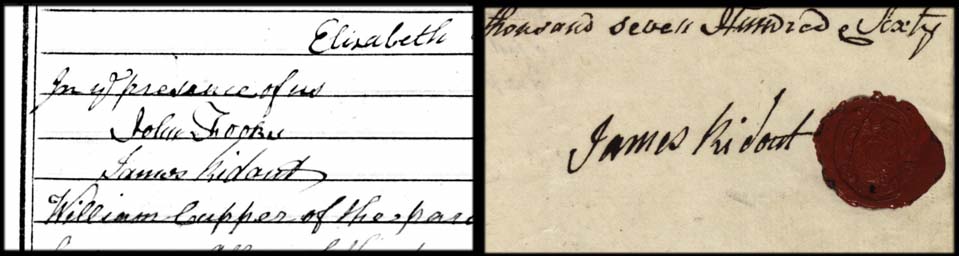
[Signed by James Ridout, Elizabeth Vie and John Fookes; mark of Martha Perrott. Probate at Sherborne on the 9th September 1767.]

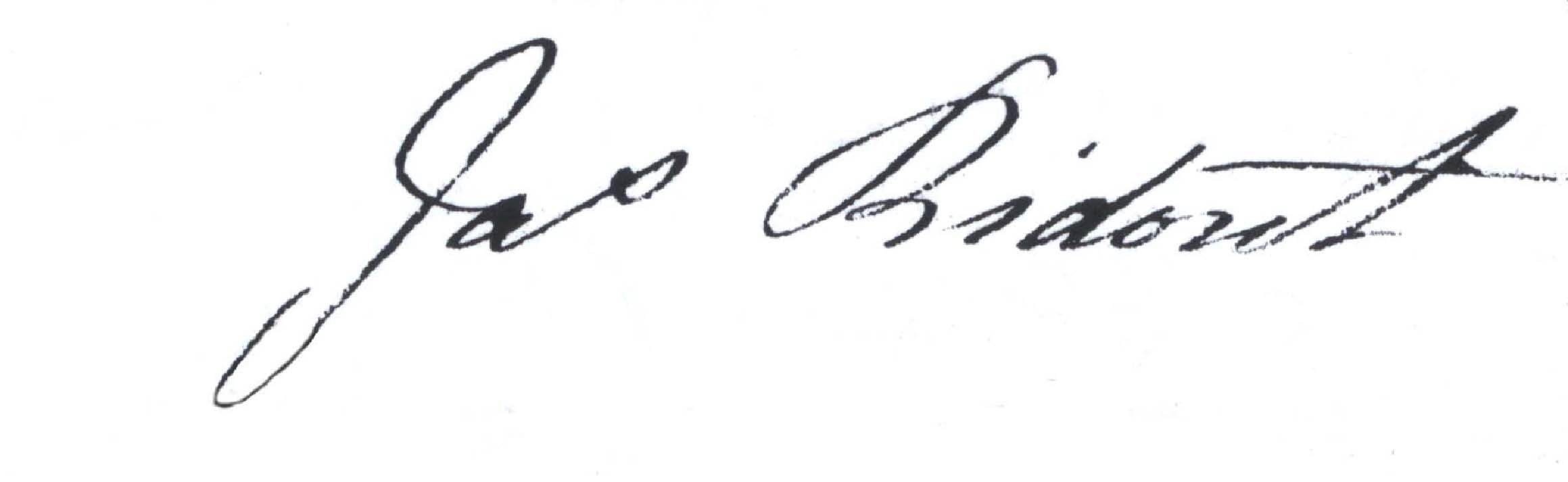
James Ridout's signature on the marriage of his sister Elizabeth (1758) and to his will (1760)

James Ridout’s signature on the marriage of his sister Elizabeth (1758) and to his will (1760)

Charles Vie Ridout, son of James and Jane (1753-1815)

Baptised on the 15th May 1753 at Folke, nearly four miles SE of Sherborne, James’s son Charles Vie went to Bristol as a young man, perhaps because it was such a bustling port and he was in the Irish linen trade. His name appeared in the Bristol Burgess Books of 1781 and, much later, in the voter’s list for the General Election of 1812. On the 18th October 1784 at St Lawrence Jewry and St Mary Magdalene in London, Charles married sixteen-year old Jane SMITH with the permission of her guardian. Interestingly, in a marriage settlement between the couple, the trustees were named as Jane’s mother-in-law Clare Blyth, a clothier, and Thomas Ridout of North Wootton, Charles’s grandfather but, after Thomas and Charles had died, the role was taken on by ‘John Ridout of New Bridge Street, Blackfriars in London’ (John Gibbs Ridout, uncle of Thomas Gibbs Ridout). In a twenty year period, between 1786 and 1806, the couple had twelve children.

Street directories of 1793-94 show that Charles was a partner in a family drapery business ‘Oliver, Ridout & Oliver’, which was located at 1 High Street and also as ‘linen merchants’ in Maryport Street, Bristol. An entry dated the 23rd February 1795 in the London Gazette (p.1456) records the theft of silk and cotton handkerchiefs from the shop by a young female. The goods, worth 10s, were ‘the property of Simon Oliver, Charles Ridout and Lionel Oliver, partners in the said shop of Simon Oliver at the parish of All Saints’ (Bristol).  In my last blog I wrote about the various Simon Olivers – this chap was probably the only surviving child of the youngest Simon (1694-1741).

On the 21st December 1805, a notice was posted in the Staffordshire Advertiser that a company partnership in Wales had been dissolved, three members having left:

dissolved

I was intrigued to see that Charles Ridout and Simon Oliver, with others, had been involved with a grocery business at Hirwaun in South Wales. The Rhondda Cynon Taff Society records: “In 1803 the (Hirwaun iron-) works passed (from Thomas Bacon) to a new partnership of Francis William Bouzer, Simon Oliver, Lionel Oliver and Jeremiah Homfray. Homfray later retired and was replaced by George Overton. After 1805 this partnership began a program of work at the site which included the construction of a second blast furnace. Unfortunately, the construction of a second furnace was not enough to save the works from a trade depression and the works were put up for sale again in 1813.” The London Gazette (January 1813) printed bankruptcy notices naming, amongst others, Lionel Oliver:

Untitled-1

I subsequently found a will for Simon Oliver, dated 20th May 1814 which was proved two months later; he wrote that Lionel, his son had been declared bankrupt (with respect to Hirwaun) and still owed him many thousands of pounds; for this reason he excluded him from his bequests.  Simon left a small sum of money to his ‘partner’, Charles. Charles Vie Ridout died from apoplexy and was buried, aged 63, on the 1st March 1815 at St. Michael’s Church in Bristol. It is probable that Simon and Charles continued their Bristol shop until their respective deaths and had been only sleeping partners at Hirwaun.

Fort Bristol

The Royal Fort, Bristol

At some point, Charles lived at the Royal Fort, a rather imposing building which now houses Bristol University’s Centre for Advanced Studies. On Sunday 2nd February 1812, he was visited at the Fort by a young Canadian, Thomas Gibbs Ridout (grandson of George Ridout the baker of Sherborne), who was staying in Bristol for a few days as part of a wider tour of England; Thomas also travelled to Sherborne and recounted:

“On my visit to Sherbourne (sic), I went to see my old grandfather’s house. I found it in ruins, the hedges are out of repair, and the avenue of trees leading to the house have their tops cut off. I also went to see the grammar school, which now consists of twenty boys, kept by Rev. J. Cutler. It was Christmas holidays. A girl came out and civilly unlocked the door. I walked up and down the room, saw the oaken benches, desks and wainscoting cut up and carved with 3,000 names; saw John Gibbs Ridout carved upon one. I went to Sherbourne church on Sunday, sat just below the old organ, and had a full view of the grandeur of this Gothic pile, which has stood unmoved in war and peace, through the storms and tempests of 700 years, its clustered pillars forming a lofty, deep arch. The mossy walls seem to defy time, and I think that seven centuries may again roll away, and this building will remain in a perfect state. After church, James Ridout showed me grandfather’s seat, near the pulpit, which I entered – the place beyond Lord Digby’s. There, on that spot, fifty years ago, sat my father [Thomas 1754-1829], in the other corner, grandfather [George 1701-1779]. Here in this church, for generations, had the family been christened and buried; but I found myself more a stranger” in Sherbourne than any other town I had been in. James Ridout, being churchwarden, showed me the parish books from 1540. In 1630 I saw the name of John Ridout in the vestry [possibly alluding to his great great grandfather].”

From ‘Ten Years of Upper Canada in Peace and War, 1805-1815: being the Ridout letters with annotations (1890).’ Author: Ridout, Thomas, 1754-1829

Portrait of Thomas Gibbs Ridout attributed to Sir Edmund Wyly Gier (1862-1957)

Portrait of Thomas Gibbs Ridout attributed to Sir Edmund Wyly Gier (1862-1957)

It seems probable that Thomas Gibbs Ridout, who had never been to Britain before, was given instructions by his father Thomas, author of the book, on which family members he should visit in England since he almost certainly didn’t run into Charles or James by accident!  

Sherborne Abbey has been changed inside long since Thomas was there; on my visit, I could not find evidence of the Ridout family pew that Thomas spoke of and unfortunately, neither could I gain access to Sherborne School in order to check out the graffiti!

James Ridout, younger brother of Charles Vie (1765-1836)

Modern Cheap St, in Sherborne

Modern Cheap St, in Sherborne

Charles Vie Ridout’s younger brother James, baptised on the 18th January 1765 at Folke, also became a draper; perhaps the business came down through Betty Vie.

James’s shop was at The Parade in Cheap Street, Sherborne – today the busy main thoroughfare of the town. Below is the wording of an advertisement published by the Sherborne Mercury on Monday the 28th May 1792:


Mercery, Linen and Woollen Draper, &c

James Ridout, Cheap-street, Sherborne, grateful to his friends for past favours, solicits their inspection of his new purchases, lately made in London, and which will be sold on the lowest terms, particularly Dimittys, Muflinettes, and White Calicoes, at very reduced prices; a great variety of Genteel Prints; Muflins of every description; an assortment of Fancy Waistcoatings, and other Articles of Dress for Gentleman’s Wear; also a good assortment of Men’s and Boy’s Hats. Light gold taken in exchange for goods, without any deductions. N.B. Funerals completely furnished.

It is not clear at what point James started in the business in Cheap St but the advertisement implies that he was not new (reference to ‘past favours’) and yet he was just twenty-seven in 1792.

On the 9th June 1796, James married Susanna PARSONS, daughter of the Rev. Francis Parsons of Yeovil and the sister of the Rev. John Parsons, Vicar of Sherborne. By the time Susanna reached the age of thirty-nine, she had borne James nine children.

Evidently James was an upright citizen of Sherborne since, as well as being a Burgess, in 1799 he became first a Governor then the Warden of Sherborne School; he was also Warden in 1815, 1821 and 1833.  According to the school’s own website, in 1823 the number of pupils, in what was then King Edward (VI)’s free grammar school, was as low as eighteen (two less than the number reported by Thomas Ridout eleven years earlier!) but, by 1845 under the headship of the Rev. Ralph LYON, numbers had steadily increased to reach 150 before declining again. Sherborne achieved independent public school status in 1871 and today is a very prestigious institution.

In the Piggott’s directories of 1823 and 1830, at Sherborne, James’s shop is entered as ‘James Ridout & Son, Cheap St’ and (only in 1830) also ‘Sams & Ridout, Long St.’ Interestingly, under Wines & Spirits Merchants, James is again listed as Ridout, James & Son (British only) Cheap St.’

Abbey Barns, Sherborne

Abbey Grange, Sherborne

Whether as a result of his business acumen or because of bequests from family members over the years, James acquired a lovely home called Abbey Grange (then referred to as Abbey Barns, it having been converted from the central part of the old barn in 1828). On a visit to Sherborne a few years ago, I found the house and was delighted when the owners allowed me into the grounds to photograph the exterior. I was not surprised to see that the extensive back garden reached the rear of the shops in Cheap Street and I was pretty sure that this had afforded a very quick and pleasant stroll to work for James! 

James died in Folke and was buried on the 9th September 1836; Susannah on the 20th February 1846. James left a very lengthy will, dated 25th April 1836, which I have condensed to include only relevant points:

“This is the last will and testament of me James Ridout of Sherborne in the county of Dorset, mercer and draper, whereby I dispose of the worldly estate wherewith it hath pleased God to bestow me in manner and form following, that is to say that first I give Susannah my dear wife all the household goods and furniture, plate, linen, china, books, pictures and liquors of all kinds that may be found in or about the dwelling house and premises where I am now or may be dwelling at the time of my decease… also I give and devise the messuage or dwelling house … situate on the Parade in Cheap Street Sherborne and with all the fixtures of the same whether for trade or otherwise to my son James and to his heirs and assignees for ever but chargeable with the payment of an annuity of twenty pounds… to my brother John during the term of his natural life… and I likewise bequeath to my son James all the household goods and furniture plate, linen and china and all the liquors which shall be found at the time of my decease but no part of my stock in trade as that I intend he shall take by purchase at a valuation as hereinafter… to my four daughters I give my pew in the Sherborne Church… whereas my life stands insured in the Equitable Office for the sum of one thousand pounds… and the accumulations which have been added I believe amount to nearly the same … now I give and bequeath the aid policy and all additions and accumulations…unto my four daughters in equal shares also I bequeath to my son Charles the sum of five hundred pounds payable at the decease of his Mother… I bequeath a policy which I have with the Royal Exchange … for the sum of three hundred pounds and all benefit to… unto and equally bequeath my sons James and Charles and my daughter Fanny and as to the messuage or dwelling house and premises wherein I now reside called “Abbey Barns” with the freehold, brasshouse, stable, outhouses and garden thereto adjoining and also the freehold messuage or dwelling house garden and premises next adjoining and now rented of me by Mrs Eastham I give and devise the same unto my esteemed friend the Reverend Ralph Lyon master of the King’s School in Sherborne aforesaid and to his heirs executors and administrators… and suffer my dear wife to have hold and enjoy the same and to receive and have the income and profits thereof to her own use and absolutely during her life she keeping the same in proper repair and from and immediately after her death then upon trust that the said Ralph Lyon, his heirs, executors or administrators do and shall absolutely sell and dispose of all the said houses and premises by public auction or by private… make payment of a legacy of ten pounds to my shopman Richard Ffoot if living with me at the time of my decease as a mark of my regard for his faithful services… the said Ralph Lyon his executors and administrators shall allow my son James who will succeed me in my business to become the purchaser of the whole or any part of my stock in trade as mercer and draper.”

Proved at London 14th December 1836 before the Judge by the oath the Reverend Ralph Lyon, Doctor in Divinity, the sole executor to whom admon was granted having first sworn by commission duly to administer.  

Links between North Wootton and Sherborne Ridouts

I have already described that Thomas Gibbs Ridout visited both Charles and James Ridout in their respective home towns of Bristol and Sherborne during the year 1812. His narrative does not inform us of the nature of their relationship but the lack of intimacy in Thomas’s description does not infer that he felt in any way close to these older men.

As stated earlier, Thomas Gibbs Ridout was the grandson of George Ridout the baker. George died in October 1786 and, interestingly, James was involved in the administration of his estate. Below is the signature from the document. James would have been 23:

sig 1

This is the signature of James Ridout on his marriage to Susannah Parsons on the 9th June 1796…

sig 2

… which appears to me, perhaps, to be similar to the first signature ten years earlier.

Another co-administrator of George Ridout’s estate was Charles Bull HART, who also witnessed the will of James’s brother John Ridout of North Wootton in 1787 (see above).  Charles married Elizabeth Vie on the 11th October 1776; Elizabeth was sister of Jane Vie and therefore Charles was James Ridout Junior’s uncle. Charles died in 1805 and bequeathed a great deal of his estate to his late wife’s nephews and nieces, including Sherborne properties and £1,000 to James, £500 each to Charles Vie and John and other bequests to their sisters Susannah and Elizabeth. One of Hart’s executors was Thomas Ridout, gentleman of Seaborough, Somerset brother of James and Charles Vie; Hart left money to Thomas’s daughter Elizabeth.

So how are the Sherborne and North Wootton Ridout families linked? I started this post by mentioning that Thomas Ridout (1682-1760) was the son of Thomas and Margrett. Arthur Ridout the Victorian genealogists recorded the elder Thomas as son of John Ridout and his wife Alice (neé Toogood). However, I believe that John and Alice’s son Thomas was a cordwainer, baptised in 1667, who went to London, married twice, had children and died in 1734 (click here). So who were the parents of Thomas Ridout of North Wootton who died in 1760? Perhaps I’ll be able to tell you next time!


Posted in General | Tagged , , , , , , , , , , , , , , , , , | 7 Comments