Benjamin Guinness Orchard was the son of George Biggs Orchard and his wife Elizabeth (née Roberts) and grandson of Isaac (see earlier posts). Benjamin was born, on the 11th June 1834, at his parent’s home in 18 Milsom Street, a prestigious area of Bath, where his father George worked as an upholsterer. Elizabeth was George’s third wife and sadly, like her predecessors, she died young. According to the Bath Chronicle, published on the 28th September 1837:
“… she had been confined seven days previous, and until within two hours of her decease appeared to be rapidly recovering her usual health. It has been ascertained that death was occasioned by the rupture of a blood-vessel in the abdomen.”
The birth in question was that of a baby girl, Elizabeth Jane, who survived.
On the 7th June 1841, when the UK census was taken, Benjamin (6 years) and Elizabeth Jane (3 years) were in Camden at the home of 65 year old Jane Roberts, who I considered might be a relative of their late mother. I couldn’t find Benjamin, or any other member of his family, in 1851. Sadly, on the 1st June 1855, Benjamin’s older sister, Caroline Anne, was buried in Bebington, a small town south of Birkenhead. She was just a year older then Benjamin and I imagine that her death came as a bitter blow to him, severing a link with their late mother.
By 1861 the boy, now a man, was an accounts clerk, lodging at 23 Ashton Street in Liverpool. He was evidently a sporty type since in June 1862 the Liverpool Mercury reported that Benjamin had narrowly missed winning medals in two events (vaulting and Indian club exercises) at the First Grand Olympic Festival in Liverpool. The athletes performed in front of thousands of spectators in what was a forerunner of the National Olympian Games.
Benjamin’s main passion in life was writing and one way or the other wielding a pen became central to his work and leisure time. He was a member of the Liverpool Young Men’s Christian Association and the Myrtle Street Chapel Mutual Improvement Society. He wrote and, over the years, presented essays to these bodies, for example: ‘The Books I Love’, ‘On Thomas Carlyle and his writings’, ‘Effective speakers’ and ‘Volcanoes and earthquakes; their causes and effects’ (during which Benjamin “argued in favour of a system he propounded, quite in opposition to the opinion of both ancient and modern geologists.”)
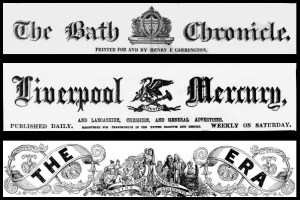
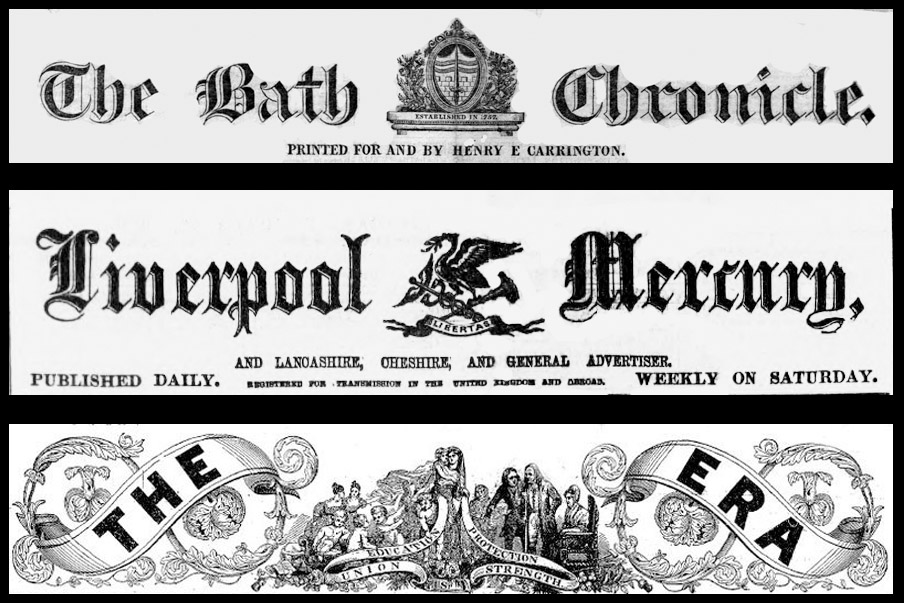
These newspapers have provided much information
In February 1864, Benjamin was appointed secretary of the Liverpool Clerk’s Provident and Annuity Association, a charity that provided funds for clerical workers who had fallen on hard times through illness or unemployment; it also recommended approved members to potential employers. During this year, Benjamin married an Irish Catholic lady called Maria Theresa Mooney, daughter of Christopher, a farmer. Over the years the couple had at least twelve children, creating a financial pressure that might have proved intolerable to Benjamin in later years.
With his love of writing, it is no surprise that the essayist eventually evolved into the newspaper reporter. He worked on several local rags before launching his own, The Liverpool Critic. His love of the written word is clear as this article shows on the 3rd of November 1876:
“Books are not made for furniture, but there is nothing else that so beautifully furnishes a house. The plainest row of books is more significant of refinement than the most elaborately carved sideboard. Give us a home furnished with books rather than furniture. Both if you can; but books at any rate. To spend long days at a friend’s house, and hunger for something to read, while you are treading on costly carpets, and sitting on luxurious chairs; and sleeping upon down, is as if one were bribing your body for the sake of cheating your mind.”
Benjamin’s newspaper career was blighted by two legal cases. Firstly, in 1871, he was indicted for libel against a professional dance troupe. The celebrity trial was known as ‘The Colonna libel.’ An excerpt from The Era, 19 November:
“The libel complained of appeared in the Liverpool Leader of the 7th October last, when Madame Colonna and her Troupe were performing at the Theatre Royal. In the course of some very severe strictures made upon the doings of the troupe, it was stated that they were “without a shred of reputation” and “scandalously indecent,” and it was added that, “while the doors of the Theatre were closed at midnight, the green-room remained open until four o’clock in the morning, and the Colonna girls stayed there to drink and flirt with such young sparks as had unemptied purses.
Benjamin was forced to write an abject apology and the case was dropped. From all reports, the ladies and their routine were quite risqué! According to a Wikipedia article, the “Can-Can as presented at the Alhambra by the ‘Parisian Colonna’ troupe proved so sexually provocative that in October 1870 the Alhambra was deprived of its dancing license.” Perhaps Benjamin was right!
The second case, in September 1876, was that of a former colleague, William Anderson, who embezzled £25 from Benjamin. Anderson had been the proprietor of the Liverpool Leader when Benjamin was its editor. When the paper failed, Benjamin set up the Liverpool Critic and was sole proprietor. He paid Anderson to do some errands but, proving unsatisfactory, he later dismissed him. Anderson then claimed that he was joint owner of the Critic and carried on collecting subscriptions for the paper, keeping the money for himself. The case went to the sessions at which Anderson made a public retraction of his claim to proprietorship and the case was presumably abandoned.
For some reason, I was unable to find Benjamin and his family in the 1871 census and then was staggered to see that, in 1881, Benjamin was an inmate at HM Convict Prison, Chatham! More shocking still was his crime. The Liverpool Mercury, dated the 29th August 1879 reported:
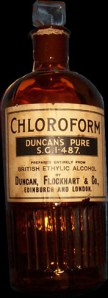
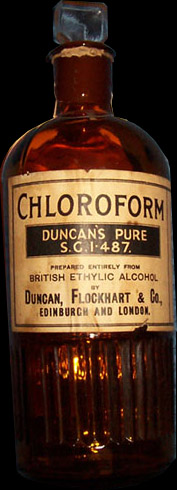
The deadly poisonous chloroform
Benjamin had left a letter for his wife which was read to the jury but otherwise was unpublished:
“The judge had considered the contents to have been that the case was a very painful one. He would have to remand the prisoner. – In reply to the usual question as to whether he had anything to say, the prisoner, who seemed to speak with considerable pain, said – “My throat is very much burned. I want to say that I did what I thought was best for my people, and I am very sorry I failed.”
During the hearing, one of Benjamin’s older sons, George Henry (14 years) gave evidence which was summarised:
“… about noon on the 27th ult. he went out with his mother, and returned about half-past one o’clock in the afternoon. He found his brother Hugh in the house running about, but he soon began to stagger, and got on the sofa, where he went to sleep. He (witness) roused him, but could not keep him awake. Witness went upstairs with his mother, and there found his sister Mildred asleep in one of the beds. He then went up another flight of stairs, and found his father lying on the floor of one of the rooms in an unconscious condition. He at once went for Dr. Davies, who arrived in a short time.”
When cross questioned George said:
“…father was always kind and affectionate. A brother of witness’s, who was nearly sixteen years of age, died about two months before the occurrence in question. The prisoner was very much attached to the deceased, who was a very studious lad. He had been editor and proprietor of a newspaper, and worked very hard day and night. The accused appeared to be broken-hearted when witness’s brother died, and he used to sit by himself and smoke all night. He was not much of a smoker previously He was a very excitable man, but he always lived on the best of his terms with witness’s mother. On the morning of the occurrence, the prisoner was very moody, and his face looked sad. In reply to the learned judge, witness said his father had been collecting for a provident society up to a short time before the occurrence, but he had given up the book. He used to talk rationally, and had his meals with the family. On the morning of the poisoning, the prisoner was walking about the house, looking at the children. His (witness’s) mother told him that his father had had no sleep for several nights.”
The brother to whom George referred was Benjamin William Guinness Orchard (1864-1879), Benjamin and Maria’s oldest child. The Liverpool Mercury, dated 29th May 1879 reported his death as having occurred two days earlier, precisely three months before this sad event.
Dr Davies said that:
“…he was called to the prisoner’s house, where he found him lying on the floor of the top room, in an insensible state. The little girl was lying on the bed in the same room, in a similar condition. The bottle (produced) containing chloroform was shown to him, and seeing that the prisoner was very ill, he, with the assistance of Mrs. Orchard and a servant, got him on the bed. Witness then administered an emetic and sent for another medical man, who brought a galvanic battery with him, which they applied to the prisoner. He recovered after several hours, and then told him (witness) that he was sorry to see him, as he wanted to die. He added that he must not suppose that the attempt upon his life was a freak, but that it was premeditated, as he had too many children. When witness saw the prisoner the next morning he (Orchard) asked him if he had any children, and he answered “No.” The prisoner then said, “Then you know nothing about it.” The children revived without any emetic being administered to them, as they vomited, The two teaspoonfuls of chloroform given to the boy Hugh would have been sufficient to kill him if he had not vomited.”
Hugh Orchard (8 years) told the court:
“…he remembered his mother and his brother George going out on the 27th ultimo, leaving his father, sister, and himself in the house. Shortly before they returned, his father, who was walking about in one of the bedrooms with a small bottle in his hand, said to him, “Do you want a sweet drink?” He answered “Yes,” and his father then gave him two teaspoonfuls of the stuff from the bottle. He soon felt very ill, and his father lifted him up and laid him on the bed. After his father left the room he (witness) got up and became very ill, and lay down on the sofa. He remembered nothing more after that. He saw his sister Mildred go upstairs, but could not say where she went to.”
Benjamin, who was allowed to question the witnesses, said to Hugh: “Hughie, do you think I love you?” to which Hugh replied “Yes, father.”
Evidence was given by assistants in two chemist shops from whom Benjamin had purchased chloroform. In each case he had explained that it was for his wife as she had pain, either from acute earache or a back injury. The prisoner was committed for trial at the Liverpool Assizes and, on the 11th November 1879, Benjamin’s case went before Mr. Justice Stephen. Mr. Commins for the defence addressed the jury:
“He said that one question was – was the prisoner well in his mind when he administered the chloroform? and another was – did he intend to do harm to the boy? He reminded the jury that the prisoner was deeply attached to his children, and submitted that there was no reason whatever to show he contemplated taking the life of any of them. He urged that the prisoner was in a state of unsound mind at the time of his conduct – especially parting with the collecting-book by which he made his living – as proof that he was not in his right sense. Twenty years ago the prisoner fell from a horizontal bar at a gymnasium, and received a serious injury at the back of the head. He had since suffered more or less from mental aberration and pecuniary losses had increased his depression and melancholy, which at times were very great.”
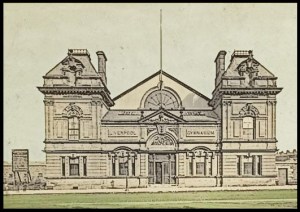
A Liverpool gymnasium
Benjamin’s half brother, Henry Langhorne Orchard deposed:
“… in the year 1856 he was living at Rock Ferry. In that year witness was with the prisoner at Huguelin’s Gymnasium, in Lord-street, Liverpool, where he met with an accident. The prisoner was in the act of vaulting over a high horizontal bar, when the pole broke, and he fell with terrible violence upon his head. For some hours he was in an unconscious condition, but ultimately was brought round. The accident seemed to affect him and he frequently behaved in a very strange manner. Some two or three years ago, the prisoner was editor of the Liverpool Critic, and sustained a loss by the dishonesty of a clerk, in consequence of which the paper was given up. This appeared to affect his mind, and at times he was exceedingly strange and incoherent in manner, while on occasion he did not at once recognise witness when he paid him a visit.”
Dr. Andrew McLennan was next called:
“He said he had considerable experience in insanity, and had attended the prisoner professionally occasionally. He was a man of a very nervous and sensitive nature, but two or three years ago he had noticed signs of mental aberration. He was of eccentric manner and gloomy, and was fond of discussing dismal subjects, such as suicides. He was melancholy and had indications of suicidal and homicidal tendency so far back as 1875. He had a particular fondness for his eldest son, who died in the early part of the year. The death was a circumstance likely to cause a severe shock to his already very nervous system.”
Mr. Fred. I. Richardson, who had formerly been proprietor of the Liverpool Leader, stated:
“that he knew the prisoner for about twenty years. There were intervals when witness did not consider the prisoner in his right mind. Many articles that the prisoner wrote for the Leader witness never used, as he considered them nonsense.”
Mary Jane Hannah deposed that:
“for about ten years she was a servant with the prisoner. She was with him in May last when his eldest son died. After that occurrence he changed in every way. His looks were wild; he used to sit up all night, and smoked a great deal. On the morning he administered the poison he had been wandering about the house, apparently without any object, and he looked very wild.”
The jury found Benjamin guilty but with a recommendation for mercy. On the following day, his Lordship said that:
“a painful task devolved upon him. He had anxiously considered the sentence he ought to pass; and he thought it his duty, in the first place, to state that he entirely agreed with the verdict of the jury. It was obvious to everyone who had heard the case that the prisoner, for reasons of his own to which he (the judge) would not further refer was tired of life and wished to kill himself. And with a sort of inverted kind of cruel kindness – if he might use such a term – the prisoner determined to kill two of his children as well, and for the purpose administered poison to them. Now that the matter was over, he might say that there was a letter attached to the depositions which was not offered in evidence, and, therefore, could not affect the jury; but it could not leave a doubt upon the minds of those who read it that it was the deliberate intention of the prisoner to kill himself and the two children. Morally, there was no difference between the administering of poison with intent to kill and the administering of poison which ultimately happened to kill. If the prisoner’s case had stood thus, and with nothing more, he (the learned judge) should have felt it his duty to have sentenced the prisoner to penal servitude for life, or for a very long term of years. But the circumstances of the case were very peculiar. The prisoner had received a strong recommendation to mercy from the jury, and that would be attended to. The prisoner’s crime must be imputed not to ferocity of to cruelty, but to a weak, cowardly state of mind. He had allowed his mind to run all kinds of subjects which it would have been better to have avoided, and he had not the self-command to stand up to the ordinary difficulties of life. He (the judge) could quite understand that some of the difficulties to which the prisoner was exposed were of a painful nature, that they arose from no fault of his, and that a man under the influence of such circumstances might commit a crime. But he could not allow it to be said that anyone who attempted deliberately from any cause, or under any circumstances, to take the life of any person could get off without very severe punishment. He would take into consideration the fact that though the prisoner was fully responsible for his actions, and though he (the judge) thought the evidence that the prisoner was mad was very unsatisfactory, yet the circumstances went to the extent of proving that, though he was not mad, he was a weak-minded man. Under the circumstances, he thought he would be justified in inflicting upon the prisoner the smallest sentence of penal servitude he could inflict. His lordship then ordered the prisoner to be kept in penal servitude for five years.”
There were many articles in the days and weeks after the trial; appeals for financial assistance for Maria Theresa and legal discussions on what constituted insanity and whether Benjamin should have been imprisoned at all. Whether he served the whole of the five years I do not know but by 1891 he was at liberty and living with his eight children at 72 Bridge Street, Birkenhead. Sadly, Marie Theresa had died of a brain embolism on the 31st March 1891. For census purposes, Benjamin described his occupation intriguingly as ‘a patentee and inventor of a game, also author.’ I was lucky to find a record of his patent, number 9770, a game called ‘seven balls’ applied for on the 3rd of July 1890.

Benjamin and his wife are buried in Flaybrick Cemetery, Birkenhead.
Benjamin died on the 7th July 1894 at Liverpool Royal Infirmary. The cause of death was described as ‘prostate enlargement and asthenia’. Asthenia, or generalised weakness, might be experienced by someone with cancer so maybe he had prostate cancer, but I am hypothesising. If Benjamin had been in hospital for a while he may not have had a post mortem; I wonder what a pathologist might have found had he examined Benjamin’s brain. Did his head injury cause his behaviour or was his condition more psychological, for example did he have manic depression? What seems abundantly clear is that for all his weaknesses, Benjamin was well loved by his family and friends, who supported him steadfastly through his troubles. He was imaginative, lively and articulate and I think I would quite have liked my fifth cousin four times removed!
In the next blog, to be posted shortly, I will back track to Benjamin’s father, George Biggs Orchard and tell you why, amongst other things, Benjamin’s middle name was Guinness!

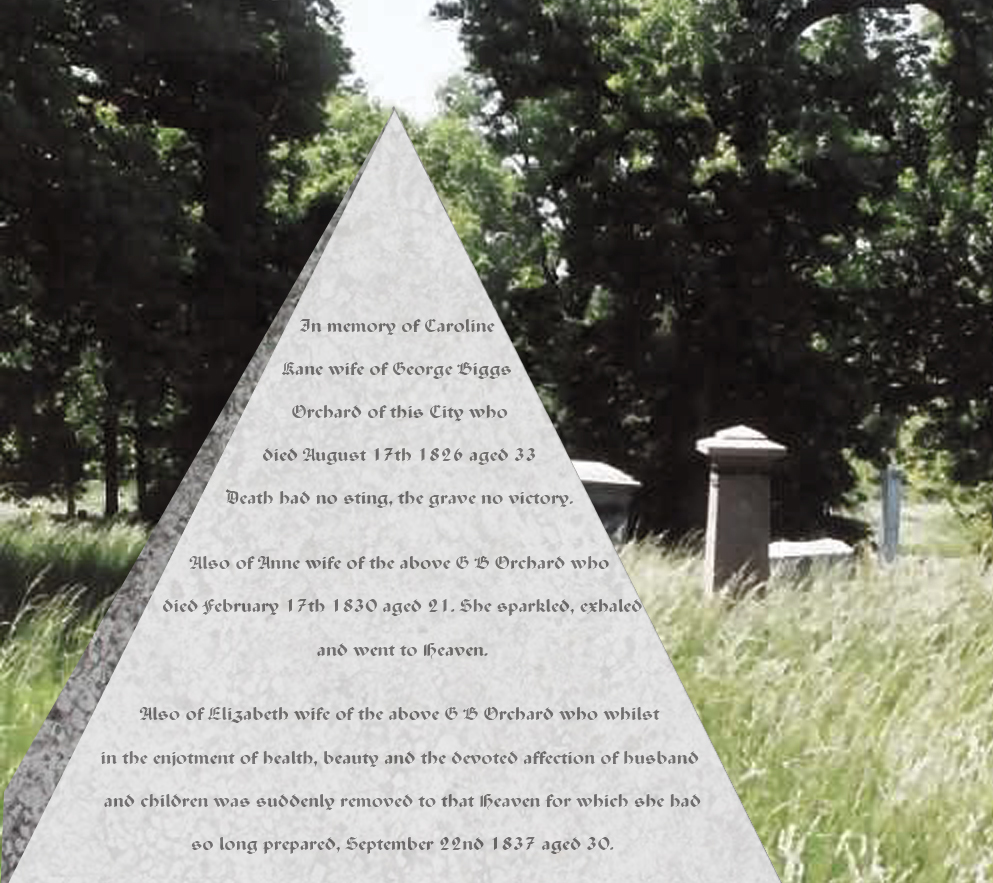








 The Ridouts of Sherborne and Bath