The Orchard family of Bath: Perriwigs, Powders and Pomatums

I have written much of the RIDOUTs of Bath, the first of whom came to the city in about 1805. These folk belong to my maternal grandfather’s side, having originated in Sherborne, Dorset. My maternal grandmother’s side came from rural Somerset and did not experience city life until quite late in the 19th century. Indeed, as I looked at all the families allied to the Ridouts, none had deep roots in Bath, which meant that in the early days of my research I never looked far back into Bath’s history, except through my own natural interest in the place. Than I found the ORCHARDs; ‘true’ Bathonians at last!

My mother’s paternal great-grandmother was baptised Laura Ann ARCHARD on 27th December 1827 in St Mark’s church, Lyncombe. Her father was Charles and he was a coachmaker and at the point when Laura was baptised the family were living somewhere along the Upper Bristol Road towards Weston, on the opposite said of the River Avon and some distance from the church. Over a twenty year period all Charles’ children were baptised at St Mark’s, so they must have felt a great affection for this small church. But Laura’s story is for another time; just recently, I have looked at her more distant family, back in the 18th century. In those days, the ARCHARDs were ORCHARDs and, if you can pronounce the word ‘orchard’ with a strong Bath accent, you will understand why.

An Orchard line that appeals to me immensely is that of the peruke makers. During most of my family history research I’ve either been sneezing from clouds of sawdust or wiping mud from my boots but here is something fresh and exciting: hairdressing! For the moment, the line starts with Joseph, who would have been Laura’s great great grandfather’s brother.
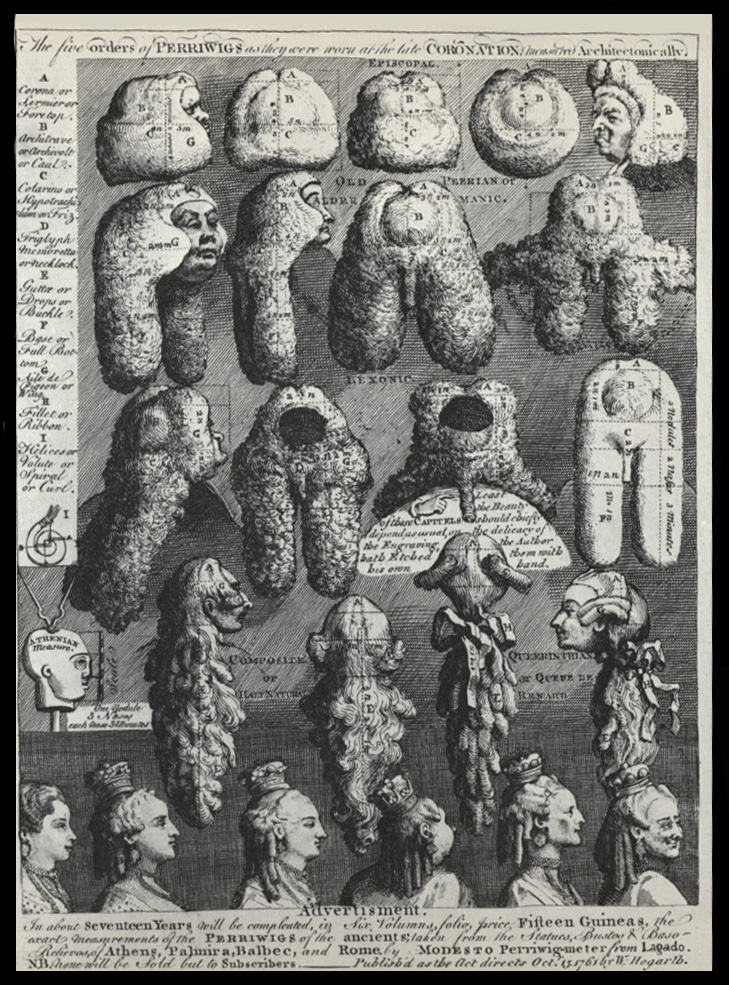
'The Five Orders of Perriwigs...' an engraving by William Hogarth 1761

The peruke [Old French perruque, head of hair; Old Italian perrucca] or periwig was a hairpiece worn by men in the 17th and 18th centuries which was made from real or artificial hair. It is said that originally this covering was an attempt to disguise the smell and appearance of unwashed hair. Clearly the periwig also became la mode and was practically obligatory for men in high social positions. Like most fashions though, these hairpieces did become rather absurd at times, as depicted by William Hogarth’s satirical sketch ‘The Five Orders of Perriwigs as they were Worn at the Late Coronation Measured Architectomically’ (1761). All that aside, it seems that the peruke maker was a truly skilled man and probably earned good money if patronised by the gentry. One can imagine the demand in fashionable Georgian Bath!

Joseph Orchard was possibly born in Bath in about 1700. There is a baptism in the Abbey in 1699, to Thomas and Elizabeth but frankly I have no idea if this is relevant. All I have seen recorded of Joseph is in the recently released online apprenticeship records. The family of an apprentice paid for a son or daughter to undertake seven years training with a master craftsman. At some point, not necessarily at the start or end of the apprenticeship, the master had to pay tax on this sum of money. The records show the name of the apprentice (and sometimes of his or her parent), the master and the date the tax was paid. From these records, I could see that Joseph was listed as ‘barber’ in 1724, after having taken on young William England, then as ‘peruke maker’ in 1729 and as ‘barber and peruke maker’ in 1738.
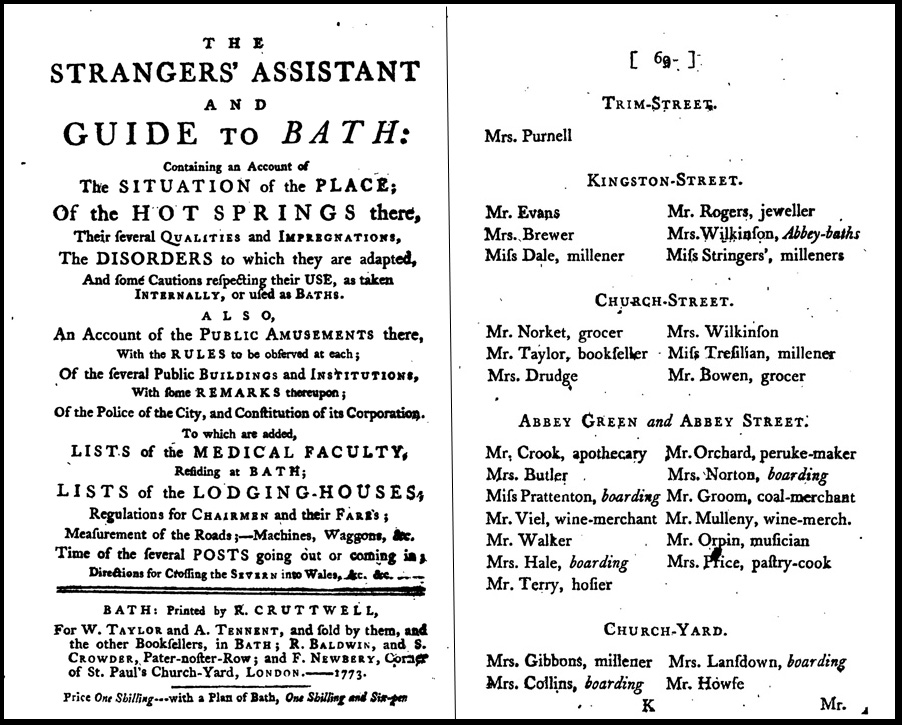
'Mr Orchard' in the Abbey Green: a Bath guide 1773

Since he appears to have fathered at least six children, I have rather assumed that Joseph married at some point, possibly in and around the early 1720s, but I’ve not found a marriage in any of my records or online. Joseph’s first born son (perhaps) was William, baptised at St James’ church in January 1728. Old maps of Bath show this building at the foot of Stall Street, just inside the city walls, next to the medieval South gate, through which the road continued on towards the River Avon. In days of old, once St Lawrence’s Bridge was crossed, the weary traveller left Bath and entered the lawless territories of Lyncombe and Widcombe! In the 1720s, however, as Bath stone was being quarried up in the hills of Combe Down and used to develop the Georgian city, so this rural area was growing too and eventually would coalesce with its rapidly expanding neighbour.
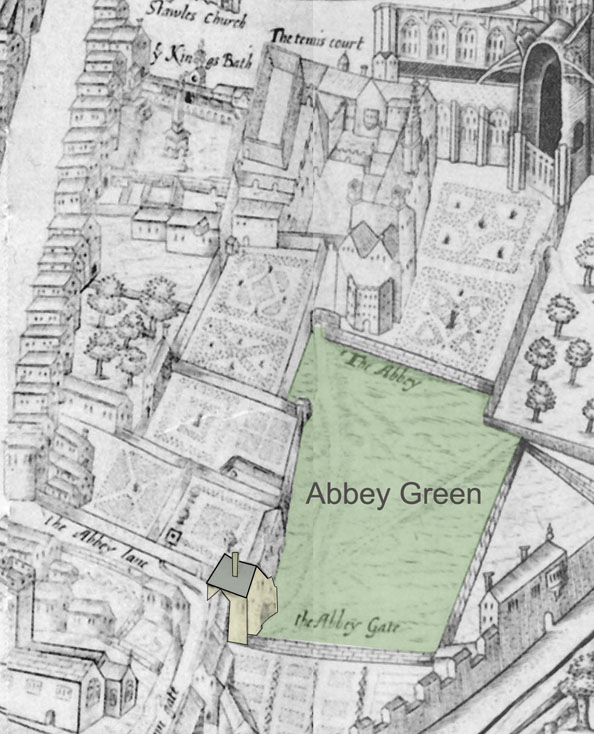
Henry Savile's map (1600) showing the Abbey Green and Abbey Gate (coloured)

William Orchard may have learnt the trade of peruke making and hairdressing from his father as I haven’t as yet found any record of a formal apprenticeship. By the mid 18th century, William was passing on the knowledge to his own apprentices, being listed rather delightfully as a ‘perriwig maker’ in the 1753 tax records but rather more prosaically as a ‘hairdresser’ by 1789. The very excellent Georgian Newspaper Projecthas given me a great deal of information with which to identify William’s business premises; which may also have been Joseph’s. The clue came from an advertisement, published on the 9th November 1780, describing the letting of a public house called The Raven in the Abbey Green. Details were to be had from the gentleman next door – Mr Orchard, peruke maker!

Joseph Gilmore's map (1694) showing Abbey Gate and a more developed Abbey Green

Abbey Green, a charming, oddly shaped square is still there, with its massive plane tree in the centre (no more than a twig perhaps in 1750). After hunting down various maps, plans and texts, it seems that The Raven public house, for those that know Bath well, was where Evan’s fish and chip shop used to be, then 7-8 Abbey Gate Street. A modern arch over the roadway, built in the 1970s, appeared to separate this building from its other half at 5 Abbey Green (which is now the NSJ Levi men’s store). Anyway, in William’s day, this large pub probably dominated the Green. Further down Abbey Gate Street (then called Lear or Leer Lane) was the original Abbey Gate, to the side of which, and so next to the pub, was Abbeygate House. In 1753 this was divided into two dwellings, occupied by William Harding, a cabinet-maker and William Orchard. Mr Orchard is still shown here in the 1771 rate book. So, that’s where the hairdressing business was – a prime spot for passing trade and occupied in the early 20th century by the first incarnation of Evan’s fish shop.

My next trip to the Bath record office, in a couple of days, will be to investigate the Orchard’s involvement with The Raven and to try and track down more hatch, match and despatches as they’re a little thin on the ground!

Abbey Green c.1905 showing Abbeygate House (Evans) right

Posted in General | Tagged , , , , , , , , | Leave a comment

The child that was born on the Sabbath Day: William Ridout (1822-1892)

“Bonny and blithe and good and gay”. I’m not sure if this describes William, son of John RIDOUT and Martha SOMERTON, or not but he certainly strikes me as enigmatic. He was born in Bath on the 3rd October 1822 and baptised in March 1824. I can imagine him being taken by his parents on a chilly spring morning up to the Countess of Huntingdon’s Chapel in the Vineyards together with his little brother Charles and perhaps other members of the family. The boys’ baptisms were conducted by the Rev. Thomas Young (1764-1844) minister of the Zion Chapel in Margate and staunch supporter of the late Countess. I wonder if William was a well behaved little boy or a fractious ‘terrible two’.

In the 1841 census, William at eighteen was described simply as a ‘turner etc’ presumably implying that he did various tasks relating to carpentry, no doubt using skills which he’d been taught by his father as later in life William would sometimes be described as a journeyman, implying his craft was learnt ‘on the job’ as an apprentice. He might have started off turning plain chair legs on a spindle lathe or perhaps he hollowed out wooden bowls using a face plate. I wonder if John’s lathe was operated by a treadle or was mechanical. William’s younger brother George was also a turner throughout his working life; I should think that finding steady work of this nature might have been a struggle, particularly in the later years.

William's flamboyant signature, aged 19 in 1842.

At the age of nineteen years and three months, William married Mary Ann SCOTT, a straw bonnet maker. The couple had lived next door to one another in Trinity Street but by 1841 Mary Ann, who was at least three years older than William, had left home and was lodging in nearby Westgate Buildings whilst he was still living with his recently widowed father. Interestingly, the witnesses to the couple’s marriage were a chap called Samuel BURGE, a twenty-one year old printer and his very soon-to-be wife, Mary SMALLCOMBE; Samuel had been lodging with William’s father in the 1841 census and so presumably the boys had become friends and decided on a double wedding in the Registrar’s Office. I noticed on Samuel’s certificate that he and Mary were married ‘according to the rites of the parties before me’, in other words as non-conformists. I had wondered if William and Mary Ann were non-conformists too but their daughter Martha Ann’s baptism at the Holy Trinity church in Walcot suggests not – her arrival just four months after the wedding perhaps explains the groom’s tender age!

More children followed Martha Ann: Emily Elizabeth (1843-1928), William Henry (1845-1912), Frederick George (1846-1848) and Alfred Charles (1848-1879).

Crest of the Ancient Order of Foresters

In 1847, William joined the Court ‘Concord’ of the Ancient Order of Foresters (AOF) in Bath and, soon after became its secretary; for a man of just twenty-five years of age, I found this quite impressive. The answers to an enquiry that I made with the Foresters Heritage Society were very helpful in describing the Order and William’s role within it:

“Court ‘Concord’, No. 2003 of the Ancient Order of Foresters (AOF) was founded in Bath in 1845. It was the practice of Courts in a particular area or region to associate with each other. The main purpose was to operate a Funeral Fund for all members in all constituent Courts. This reduced the likely burden on any one Court experiencing say an influenza epidemic and having to pay out a large amount of money at one time. There were also administrative reasons for Districts – they provided a conduit through which the National Executive Council of the Order could communicate with Courts without having to write to them all individually, but rather using the District set up for that purpose. Bro. Ridout was the Secretary of two Courts and the Bath United District, so paperwork must been one of his strengths. Secretaryship of the District was no small enterprise; in 1890 it comprised some nineteen Courts in and around Bath.

The Bath Amalgamated Medical Institute was founded in 1884. The purpose of this organisation was to provide medical treatment and medicines for members and families of all contributing constituent friendly societies. In Bath in 1890, the Medical Institute was subscribed to by fourteen societies, with 2,053 members. Receipts for 1888 were £658, payments £568.

The Foresters Hall, Bath first appears as a meeting place in the Foresters’ Directory for 1884, implying that it was opened in 1883. Changes in outlook meant that progressively Foresters Halls were seen as more appropriate meeting places than pubs. They were usually erected following an appeal for funds. The Bath Foresters Hall was, by 1890, being used by eight Courts, as well as the AOF Bath District Juvenile Society, AOF Bath United District Widows and Orphans Fund (Sec: W Ridout) and the Medical Institute. Administering the Hall appears to have been another of Bro. Ridout’s activities.”

The 1851 census showed William and Mary Ann together with their children Emily Elizabeth, William Henry and Alfred Charles. Also staying or living with the couple were John, William’s father and Edwin, his younger brother. The address was 18 Upper Trafalgar Place, which was in Holloway. I imagine this was only a modest sized cottage so things must have been a bit of a squeeze. By 1861, William and his two sons were in 5 Caroline Buildings, a pleasant rank of houses at the Widcombe end of Pulteney Road. There was no sign of Mary Ann though and, despite thorough searching, I have been unable to find her.

The 1871 census recorded William, still a married man, at Prince’s Buildings in Bath with his ‘sister’ Margaret E TROUSDELL, a forty year old widow. Initially, this completely confused me as I had no idea who Margaret was but, when I found that the couple would get married on the 3rd September 1873, it suggested that William had spared Margaret’s blushes, and perhaps his own, by being slightly economical with the truth on his census return! But, where was Mary Ann in 1871? Still missing! So, if William really had been married in those censuses, presumably his wife had died between the 1871 census night i.e. 2nd April and William’s marriage in September 1873. A search of the records does show that a Mary Ann Ridout had died in St Pancras during the second quarter of 1873 (her son William Henry was possibly living there too). I’m going to have to order the certificate and see what transpires… Meanwhile, back to William and Margaret…

Her marriage certificate showed that Margaret, whose maiden name was BLATCHLEY, had been married to John Trousdell a painter, eighteen years her senior, who had left her widowed in 1866. William and Ellen were together for twenty-six years until death claimed her at the age of sixty-two. She was buried in the Abbey cemetery but, although I visited this closed, rather overgrown wildlife haven, I did not find a stone marking Margaret’s grave.

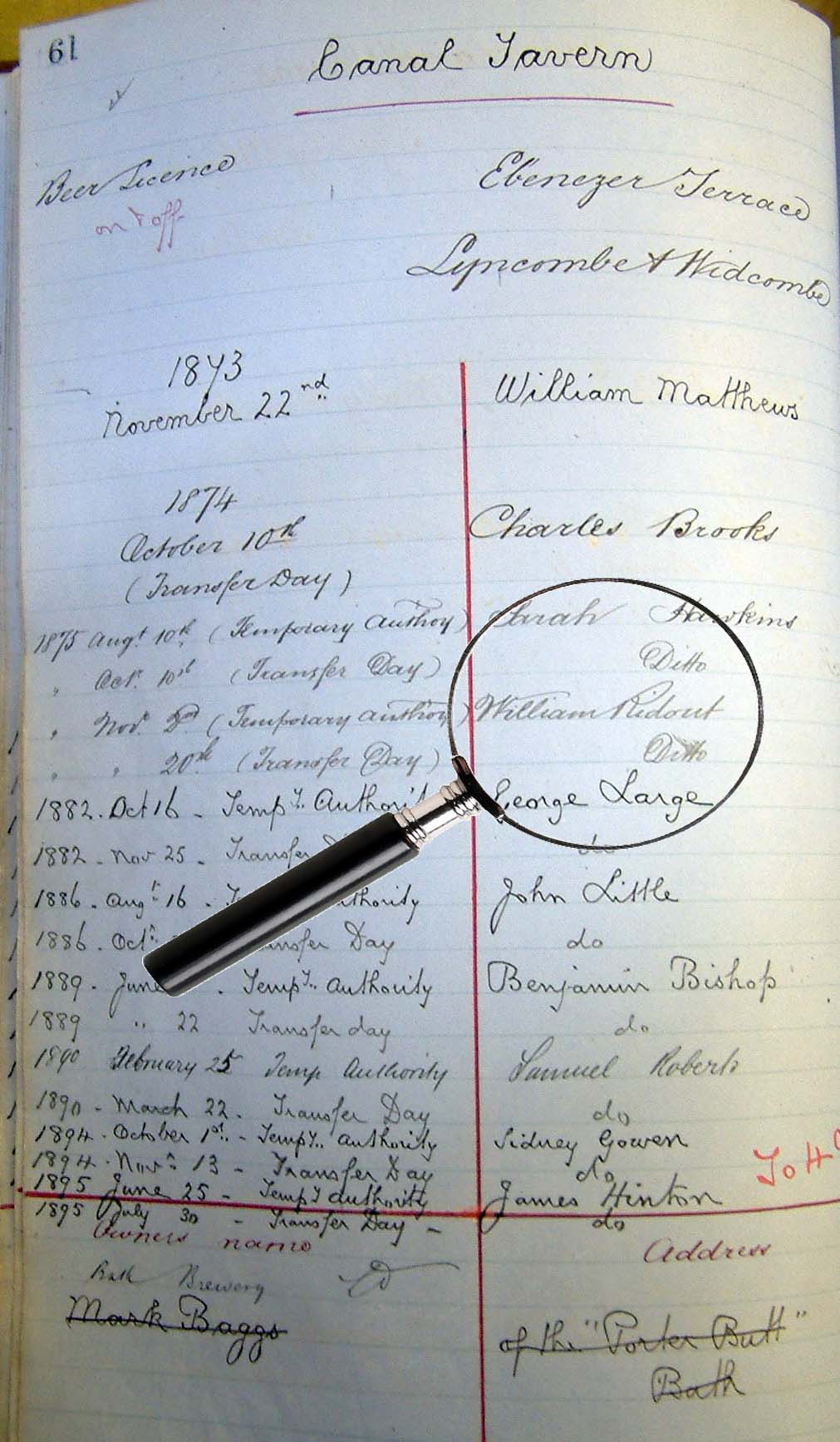
Licence transfers for the Canal Tavern. William's entry in 1875.

On 20th November 1875, William was granted the licence of the Canal Tavern public house, at the junction of 1 Ebenezer Terrace and Coburg Place in Widcombe. According to Andrew Swift and Kirsten Elliott’s excellent book ‘The Lost Pubs of Bath’, this was a “fairly opulent establishment with its own brewery”. In 1908, the Widcombe Baptist chapel’s schoolroom was built where the pub had been. Behind, the Ebenezer Chapel blazons evangelical messages on its roof: ‘Prepare to meet your God’- a prospect I always found rather frightening as a small child! Anyway, William kept the licence until November 1882 and so was recorded here in 1881 as an ivory and hardwood turner. This signified to me that he was a really skilled craftsman as he was working with such expensive materials. So, by his late fifties, William still turned the lathe, ran a pub and organised several AOF Courts – he was certainly no Victorian couch potato!

Cottell's map showing numbers 3 and 4 Bath Street.

In 1891, William was at 4 Bath Street, probably the address of the Forester’s Hall. Although he was ‘retired’, I wouldn’t be surprised if he had still been working for the AOF. On this particular April day, William was with a fifty-four year old lady, Ellen NOOK. I can only speculate on what their relationship might have been – was she a friend, a visitor or did they enjoy a more intimate relationship? The couple had not disclosed the nature of their connection to the enumerator. By this time, William was sixty-eight and entering the final year of his life. Maybe Ellen was his nurse.

William died of pneumonia on the 2nd May 1892. I hope his illness was bearable and his end peaceful; I think he deserved it. He has the honour of having the only published obituary in my family that I have as yet found. The piece appeared in the Bath Chronicle on May 12th 1892.

William's obituary: May 12th 1892

The Heritage Society also kindly provided me with a transcript of a short notice which had appeared in the pages of the ‘Foresters’ Miscellany’:

“The members of the Bath United District have suffered a sad blow in the death of Bro W Ridout, who for so many years has discharged the duties of District secretary. Bro Ridout was also secretary of the Foresters’ hall and of the Bath Friendly Societies Medical Institute and at the time of his death had entered his 70th year. The burial took place in the Abbey Cemetery on Thursday 5th May, when a large number of members and friends attended to pay their last respects to his memory. Upon the conclusion of the usual service, the funeral service of the Order was read in an impressive manner by Bro Foxwell, DCR.”

NB. DCR: District Chief Ranger.

Even after his death, William’s duty to the Foresters lived on. His will comprised complex instructions which, when interpreted, meant that everything he owned went, not to his family but to two trustees who would administer a ‘Ridout Fund’, paying the interest on his invested capital once a year to whichever Court in Bath showed the best balance sheet! William wanted to be remembered. His grave, like that of his second wife, is in the Abbey cemetery and is now unmarked by a stone, if there had ever been one. The detail in the burial register shows that he had his own new, private plot, not sharing with anyone. A hard working man; utterly dedicated to his one passion – I wouldn’t be surprised if perhaps his private life had lacked a little something?

Posted in Individual | Tagged , , , , , , , , , | 2 Comments