
George Ridout, the miller and baker of Sherborne (1701-1779) had married twice. By his first wife Mary Hallett, he had many children, including John (1730-1797) and by his second wife, Mary Gibbs, George had two more sons, one of whom was Thomas (1754-1829). John went to America in 1753 and half brother Thomas followed him in 1774. John had settled in Annapolis, Maryland, married a governor’s daughter and was a close friend and personal secretary of Governor Horatio Sharpe, a relationship which would one day see Ridout owning Sharpe’s thousand acre estate and house at Whitehall. Thomas Ridout initially went to Annapolis but, after many adventures, he moved and settled in Canada in 1788 and held many prestigious positions in his time including Sergeant-at-Arms to the House of Assembly in 1794, Surveyor General of Upper Canada in 1810 and Member of Parliament in 1812. Married twice, Thomas had many children including George (1791-1871) and Thomas Gibbs (1792-1861).
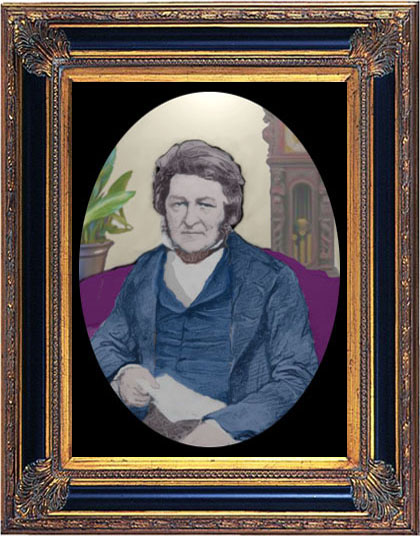
Thomas Ridout (constructed from a pencil sketch in 1812)
In 1812, at the age of nineteen, young Thomas Gibbs Ridout sailed across the sea to England to seek his fortune, if opportunity presented itself. He wrote many letters to his father and brother George during his travels including an interesting diary entry, dated Sunday 9th February 1812, concerning a brief visit to Sherborne, Dorset – his ancestral home.
“On my visit to Sherborne, I went to see my old grandfather’s house. I found it in ruins, the hedges are out of repair, and the avenue of trees leading to the house have their tops cut off. I also went to see the grammar school, which now consists of twenty boys, kept by Rev. J. Cutler. It was Christmas holidays. A girl came out and civilly unlocked the door. I walked up and down the room, saw the oaken benches, desks and wainscoting cut up and carved with 3,000 names; saw John Gibbs Ridout carved upon one. I went to Sherborne church on Sunday, sat just below the fine old organ, and had a full view of the grandeur of this Gothic pile, which has stood unmoved in war and peace, through the storms and tempests of 700 years, its clustered pillars forming a lofty, deep arch. The mossy walls seem to defy time, and I think that seven centuries may again roll away, and this building will remain in a perfect state. After church, James Ridout showed me grandfather’s seat, near the pulpit, which I entered—the place beyond Lord Digby’s. There, on that spot, fifty years ago, sat my father, in the other corner, grandfather. Here in this church, for generations, had the family been christened and buried; but I found myself more a stranger in Sherborne than any other town I had been in. James Ridout, being churchwarden, showed me the parish books from 1640. In 1630 I saw the name of John Ridout in the vestry.”
This passage and many others of interest are to be found in a volume entitled ‘Ten Years in Upper Canada: Peace and War 1805-1815’ having been collated and annotated by Matilda (Ridout) Edgar, daughter of Thomas Gibbs Ridout and wife of Sir James D Edgar. The volume was published in 1890. Lady Edgar also wrote a book called ‘A Colonial Governor in Maryland 1753-1773’, published in 1912. This is the story of Horatio Sharpe, his life and times as Governor of Maryland, a position which he took up in 1753 having travelled from his native Yorkshire taking with him a young John Ridout, as his secretary.
Much as I have enjoyed reading these two books, I was ‘surprised’ to read the following passage in the later volume:
“John Ridout, the youngest of the trio, was born at Sherborne, Dorsetshire, England, in 1732, and was there fore but twenty-one years old when he arrived in Maryland. He had just graduated at the University of Oxford after five years’ residence there, and had been recommended for the position of secretary by his Hebrew professor to Dr. Gregory Sharpe, who had been commissioned by his brother the governor to find him ‘ a scholar and a gentleman ‘ to accompany him to America. That the place of secretary was no sinecure the voluminous correspondence preserved in the archives of Maryland bears witness. Of Huguenot descent, for the Ridouts had left France in the sixteenth century, presumably on account of the religious persecutions in that country, John Ridout was throughout his life firm in his convictions, straightforward in his conduct and, as became his ancestry, somewhat austere. He soon won the esteem and affection of Governor Sharpe, whose letters bear testimony to the worth of his young secretary.”
There was also the following footnote, information acknowledged by Lady Edgar as having been provided to her by Dr William Govane Ridout of Annapolis, great grandson of John Ridout, who would have been about seventy-six at the time, I think:
“The Ridouts (spelt also Rideout) of Sherborne, were descendants of Thomas Ridout of Henstridge, Somerset. The family came originally from France from the neighbourhood of Fontainebleau and settled in England about the middle of the sixteenth century. In Hutchins’ Visitation of the Somerset, now in the College of Arms, London, mention is made of the granting of a coat-of-arms in 1551 to Thomas Ridout of Henstridge. These arms bear a striking resemblance to those borne by the de Rideouts de Sance (see Hozier’s Armorial General of the French Nobility), near Fontainebleau. In the will of Walter Ridout of Langlin, Dorset, a descendant of Thomas, dated 1582, among other legacies he bequeaths a large sum of money to the church at Fontainebleau. Christopher Ridout, son of Thomas, was baptized at Henstridge, Somerset, 24th November 1664, and settled in Sherborne, Dorset. His eldest son, George, born at Sherborne in 1702, was the father of the John Ridout who came to America with Horatio Sharpe.”
Appearing as it does in such an authoritative and well written book, this paragraph has probably contributed to generations of Ridouts thinking that their ancestors were French Huguenots! As a genealogist, I see it as my duty to at least provide some alternative information so that interested parties might make their own judgement but I know that, once entrenched, these myths are hard to dispel and people will want to hold onto their beliefs which is, of course, their prerogative. The two points I offer in ‘evidence’ are these. Firstly, as already discussed in earlier posts, George Ridout the baker was son of Christopher Ridout of Sherborne (bp. 1669) NOT Christopher Ridout of Henstridge (bp. 1664). Secondly, an examination of the will of Walter Ridout of Langham, Gillingham, dated 5th September 1582, shows that he made a bequest not to the church in Fontainebleu, France but to the parish church of ffountmealle, which is an archaic spelling of Fontmell – as in Fontmell Magna, in Dorset! He left the church 16 pence.

The Henstridge Ridout line is distantly related to the Sherborne Ridout line, according to yDNA test results anyway, and is also apparently of Celtic origin, not Norman descent i.e. French Huguenots! I can say with some conviction that these families are Dorset folk as far back as records can show – and so, therefore, are American and Canadian Ridouts who descend from ‘George the baker’.




 The Ridouts of Sherborne and Bath