
The earliest known member of the Sherborne RIDOUT clan was a chap called William RIDOWTE. If one supposes a likely age for a man at marriage being 20, then William may have been born in the early 1550s. He was a yeoman, which Wikipedia defines as ‘a free man holding a small landed estate, a minor landowner, a small prosperous farmer’. In other words, William was not a serf working the land solely for the benefit of the lord of the manor but had some small measure of control over his own life and fortunes. William married a lady called Agneta (or Agnetha) BARNARD on 15th October 1572 in Sherborne Abbey.
For many family historians, being able to identify family events during the reign of Charles I is just a dream but, fortunately for me, a man called Arthur George RIDOUT (1852-1939) was as passionate about our family history as I am. For him it was a true labour of love. There was no internet, no computers in his day – with just a pencil and notebook he made frequent outings to Somerset House and other, now defunct, repositories. Over years of his life he, along with his wife and son, transcribed incredibly detailed amounts of information about various RIDOUT families. Arthur’s many notebooks were later patiently copied into digital format by another family historian, the late William (Bill) RIDOUT. A few years ago, Bill kindly gave me a copy of his entire work, the original of which is lodged with the Society of Genealogists in London. From this I discovered that, in September 1888, Arthur and his wife Beaujolais had visited Sherborne and transcribed all the RIDOUT baptism, marriage and burial entries from the Abbey parish registers, which date from 1558!
Going back to William and Agnetha’s story, the couple had two sons: Thomas (b. 1574) and William (b. 1577). Agnetha died and was buried in Sherborne on the 21st January 1619 and William died and was buried on 30th June 1621. Happily for me, William made a will, the contents of which gave me a fascinating glimpse into his life. I struggled to decipher a few of the words, hence the odd gap here and there in my transcription! The spelling is quite unfamiliar in places and the use of capital letters and punctuation do not, of course, conform to our modern rules. Below is the image of William’s copy will, this is not the original – when each will was written, a legal clerk copied the contents into a book and it is these that have survived in many cases. I have added a few commas here and there to make it easier for you, the reader, to understand. Any text in square brackets is my own…
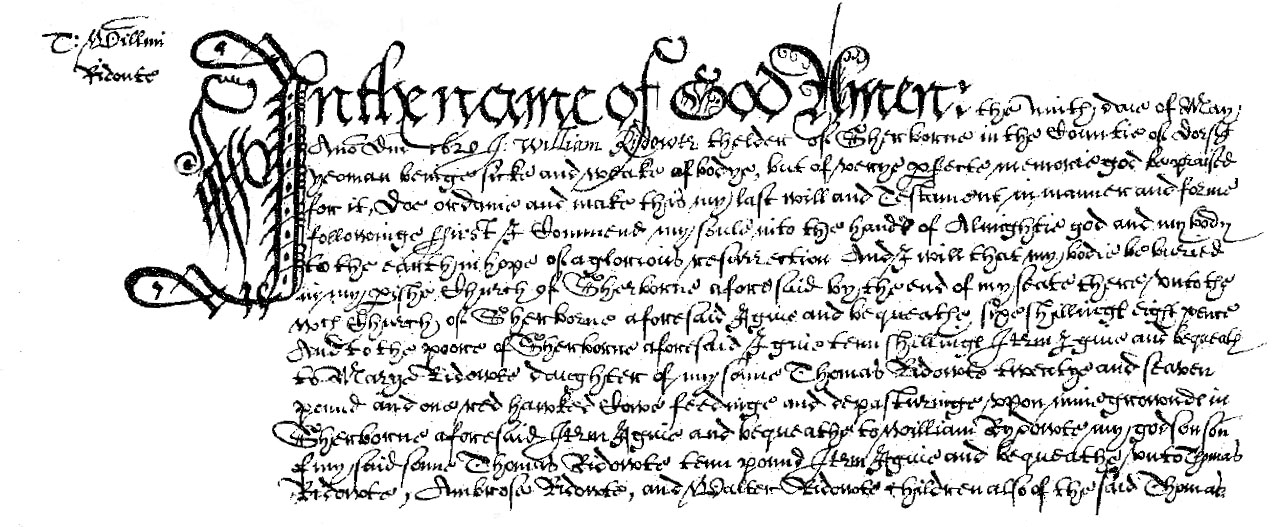
William RIDOWTE's copy will 1620
The Will of William Ridowte the elder of Sherborne
In the name of God Amen. The ninth day of May Ano Dm [AD] 1620, I William Ridowte the elder of Sherborne in the Countie of Dorset, yeoman, being sicke and weake of bodye but of sound and perfect memorie, God be praised for it, Doe ordaine and make this my last will and Testament in manner and forme following.
ffirst I Commend my soule into the hands of Almighty god and my body to the earth in hope of glorious resurrection. And I will that my body be buried in my parish church of Sherborne aforesaid by the end of my seate there [he paid for a seat in the Abbey]. Unto the church of Sherborne aforesaid I give and bequeath sixe shillings eight pence. And to the poore of Sherborne aforesaid I give ten shillings. Item I give and bequeath to Mary Ridowt, daughter of my sonne Thomas Ridowte, twenty and seven pounds and one red cawled cowe [red coated cow] feeding and depastureing upon mine ground in Sherborne aforesaid. Item I give and bequeath to William Ridowte my godson, son of my said sonne Thomas Ridowte, ten pounds. Item I give and bequeath to Thomas Ridowte, Ambrose Ridowte and Walter Ridowte, children of the said Thomas Ridowte my sonne five pounds apiece. Item I give and bequeath to Robert Ridowte, Richard Ridowte, Julyan Ridowte and Agnes Ridowte children of the said Thomas my sonne four pounds apiece. Item I give and bequeath to my godson William Ridowte, son of my sonne William Ridowte, ten pounds and unto Thomas Ridowte, my sonne Williams son, also six pounds and unto Agnes, my son William his daughter, I give and bequeath twenty pounds. Also I give unto Johane Ridowte his daughter upon his second wife ffour pounds and to my servant Mary Richman twenty shillings. And I give to every of my godchildren twelve pence apiece. Item I give and bequeath to my sonne William Ridowte my musket, headpiece [helmet] and bandoleere [belt for carrying ammunition] and to my sonne Thomas I give my callyver [musket]. and unto my sonnes Thomas and William I freely forgive all such debts as they doe owe me further I will that my brewing pan do remain in my house to my sonne William during his life and afterwards to his son William Rydowte my godson forever. Item I give unto the foresaid Maria [Mary] Ridowte, my sonne Thomas his daughter, the standing bedstead and bed wherein I now lye together…. Furniture to the same belonging and appertaining. And unto Agnes Ridowte, my son William Ridowte his daughter, I give my bedstead and bed… all furniture remaining in the lift over my chamber and wherein my mayden [maiden, possibly Mary Richman, his servant] do now lye. Item, I give to William Ridowte, Thomas Ridowtes son aforesaid, one cowe about three yeares of age now depasturing in the Moores in Sommerset [probably grazing on common land]. Item I give to Julyan Ridowte, my sonne Thomas his daughter, a platter [plate] and a pottinger [porridge dish] and the chest that stands in my bedchamber I give to Marye Ridowte, my son Thomas his daughter. I give and bequeath unto my sonne Thomas Ridowte my lease of Cuffs tenement. Item I give and bequeath unto my son William Ridowte my lease of Hyle [Hyle Farm in Sherborne] and all the yeares of and with same yet to come and all the cows in and upon the same now depasturing. Item I give unto Mary Ridowte, my son Thomas his daughter, my best cloke [cloak] and the second best cloke I give to Agnes Ridowte, my son Williams daughter, and to the said Mary, Thomas Ridowtes daughter, I give one brass pot and four platters and one candlestick, and one candlestick to Agnes Ridowte, William Ridowtes daughter, and one candlestick to Julyan Ridowte, Thomas Ridowtes daughter. Item I give unto the said Thomas Ridowte my sonne, one acre of barlie [barley] upon Palmers ground in Clanfield and one other … upon the said Palmers ground in Haberfield and two acres of wheate upon Ridgewaie [Ridgeway]. I give and bequeath unto my sonne William one acre of wheat abouve Yuillewaie [Yuleway] being of high ground. To the said Thomas Ridowte and William ridowte, my sons, I give and bequeath unto each of them a good cowe and one yearling calf bred … by hand. I give unto Julyan, my sonne Thomas his daughter, and to Agnes his daughter I give two platters. The rest of my goods moveable and non moveable whatsoever not before given nor bequeathed I give and bequeath unto Agnes Ridowte, my son Thomas his daughter, whom I make my soul executrix of this my last will and testament and I do request my sonne Thomas Ridowte and my cousin John Hoddinott to be overseers of this my last will and testament and unto the said John Hoddinott I give ten shillings for his pain in that behalf. In witness whereof I have hereunto put my hand and seal the day and year above written, 1620.
The hand, mark and seal of William Ridowte the testator. signed sealed and delivered to Thomas Ridowte one of the overseers to the … of the said Agnes Ridowte executrix in the presence of John Bealye.
The sign of ‘H’ Agnes Ridowte, daughter of William Ridowte
The sign of ‘A’ Marie Ridowte
The sign of ‘W’ Edith Ridowte
The sign of Marie + [marked with a cross] Richman.
From this will, one can see that William had a female servant, was possessed of firearms (as one would expect of the time), a smallholding, a couple of tenanted houses, livestock and crops. The amount of cash money that he left was roughly equivalent to £10,500 today. Best of all though is that, if you can work out the complexities, this type of detailed will can help you construct a family tree. William had two surviving children and thirteen grandchildren at the time of his death in 1621.


 The Ridouts of Sherborne and Bath