
The earliest point that Christopher Ridout is known to have had some interest in the Primsley tithing of Sherborne was in 1709, when he was forty years old. Christopher was an assignee of Thomas Hobbs, a gentleman, who held the lease of Primsley Farm from the Lord of the Manor, William Lord Digby, Baron of ‘Goatshill’ (actually Geashill, in Ireland). This lease was for a term of lives where the ‘lives’ were Thomas Hobbs, Anne his wife and Mary Napper (daughter of Samuel Napper). The property in question was two acres of land, part of the Primsley Farm estate, comprising a house, garden, orchard and backside (yard at the rear of the house) which were on a street called Westbury. Also about eleven acres of meadow land called Raw Meade.
By 1720, Thomas Hobbs had died and the property reverted back to Lord Digby who, on 26th July, leased it out to Christopher Ridout, miller and Thomas Loaden, baker both of Sherborne, for a payment of £62-6s-0d. The lives were amended to include Elizabeth, Christopher’s daughter.
In 1735, Christopher still held this lease, together with Thomas Ridout. The ‘lives’ were Mary Fox (nee Napper, now a widow), Rebecca Loaden and Elizabeth Ridout. Presumably Anne Hobbs had also died. Interestingly, a separate moiety of Primsley Farm had been re-named Limekiln. Limekiln Farm exists today and is not far away from Hyle Farm.
Christopher died in 1743 and was buried in Sherborne on the 1st June. Intriguingly, the entry in the parish register states ‘Christopher Ridout from workhouse was buried’. As there is no suggestion that Christopher was destitute, a possible explanation is that the workhouse also functioned as a hospital in which he may well have been a patient. He had written his will less than a month before dying:
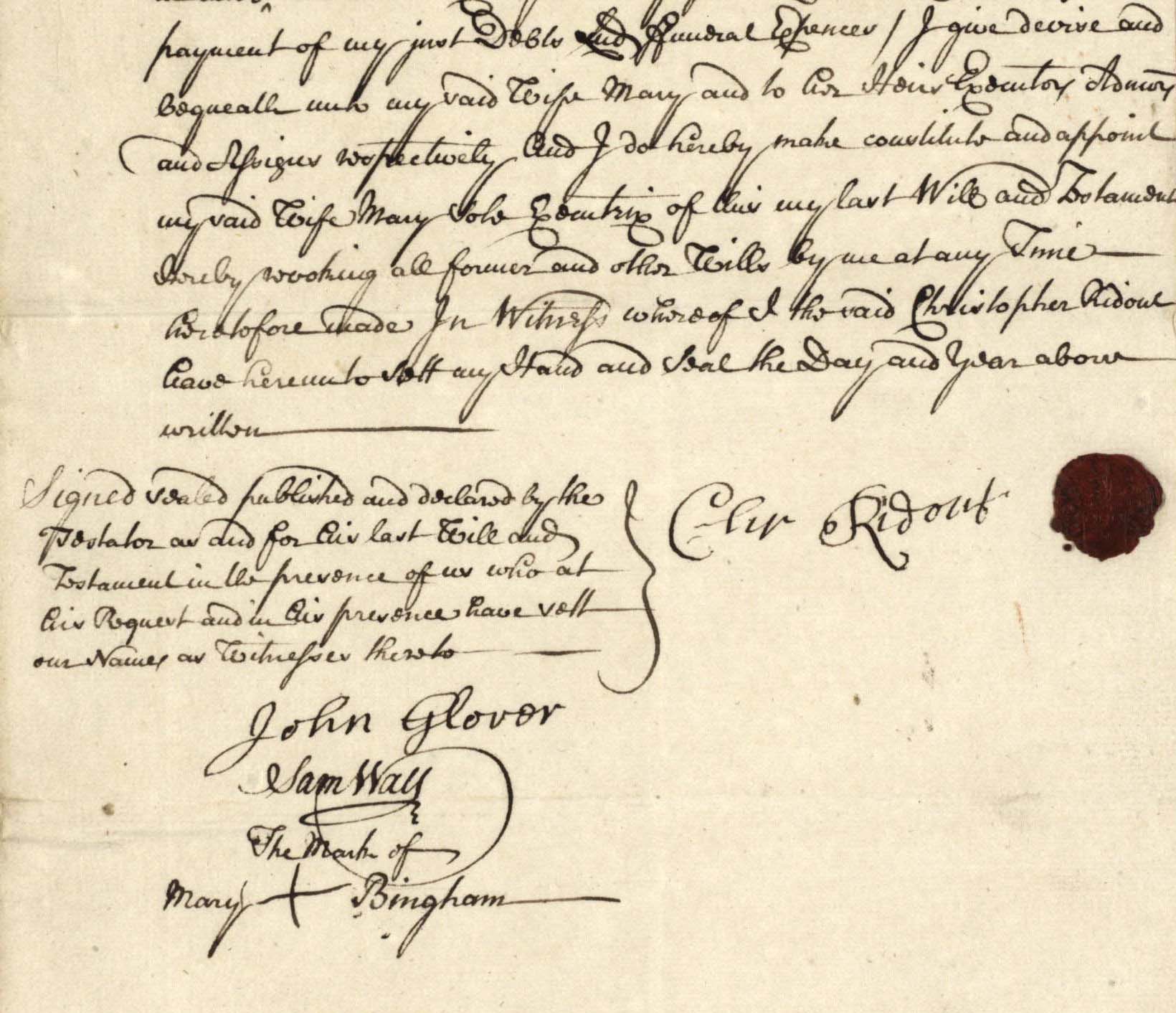
Christopher Ridout's will
“By this my last Will and Testament made this seventh day of May one thousand and seven hundred and forty three, I Christopher Ridout of Sherborne in the County of Dorset Yeoman do give and dispose of my worldly Goods and Estate in manner and fform following that is to say In the first place I give devise and bequeath unto Mary my loving wife all that my piece of land lying in the common ffields of Sherborne aforesaid containing about One acre & halfe & now in the possession of John Lukus with the appurtenances thereto belonging To hold to my said wife and to the Heirs and Assigns forever. Also all the rest and residue of my Real and personal estate whatsoever and wheresoever the same do lye and whereof I shall die seized or possessed or any way intituled unto. And also all singular my Goods Chattles & Credits after payment of my just Debts and Funeral expenses I give devise and bequeath unto my said wife Mary and to her Heirs Executors Admon and Assigns respectively. And I do hereby make constitute and appoint my said Wife Mary sole executrix of this my last Will and Testament hereby revoking all former and other Wills by me at any time heretofore made. In Witness whereof I the said Christopher Ridout have hereunto sett my Hand and Seal the Day and Year above written.”
This Will was proved at Sarum on the fourth day of July 1743 before the Reverend John Talman Clerk M.A. Lawful Surrogate of the Official of the Dean of Sarum.
In the 1748 Sherborne Manor estates survey, the moiety of Primsley Farm was entered under Christopher’s assigns and hence his widow Mary and son George remained lives on the tenancy and may also have occupied the property. George also had a tenancy of Little Raw Mead, five acres of meadowland nearby for which he was granted the lease ten years later by Lord Digby.
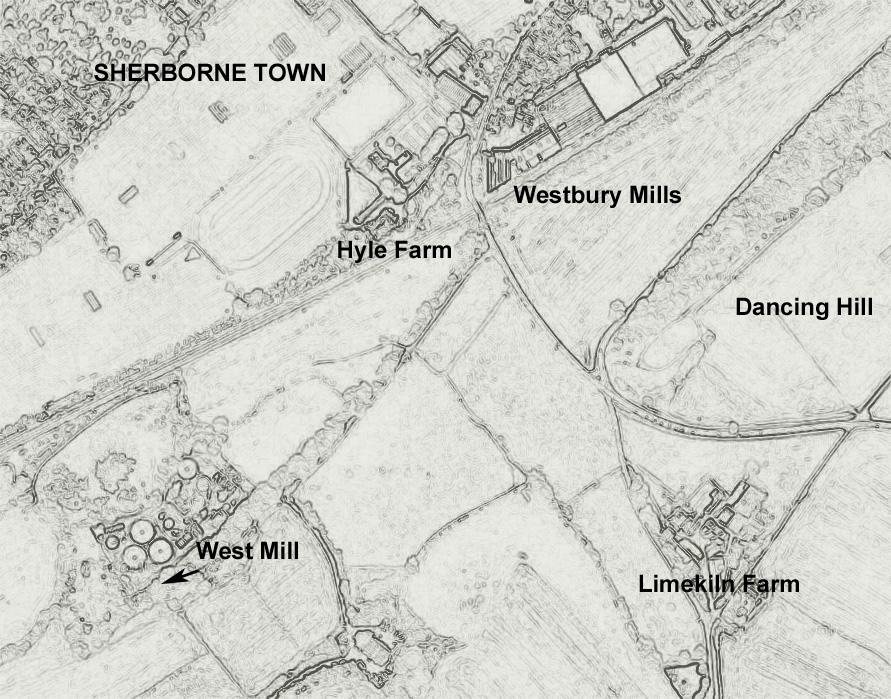
Sherborne map to show places of interest
The various Sherborne Manor surveys, contracts and accounts make it clear that whilst William Ridout had a tenancy of Hyle, first Christopher and then his son George had tenancies in the neighbouring tithing of Primsley Manor. Modern maps still show Hyle Farm and Limekiln Farm but where was the mill in which Christopher then George worked? Here at last, I think, is the answer….
According to documents held by the Dorset Record Office, a silk-throwing business was established in 1753 by John Sharrer, a London silk-thrower, who leased Westbury Mill and built a new mill-house. Westbury Mill was clearly shown in the revised 1901 OS map of the area but has long since been used for other purposes and these days is referred to as the Old Yarn Mill. Its location is just across the road from Hyle Farm.
An indenture between Lord Digby and John Sharrer incidentally makes reference to Ridout’s Mill and indicates that it was almost certainly what was later called West Mill…
“This indenture made the second day of April in the twenty eighth year of the reign of our sovereign Lord George the Second by the Grace of God of Great Britain France and Ireland King Defender of the Faith and in the year of Our Lord one thousand seven hundred and fifty five between the Right Honourable Edward Lord Digby and Henry Digby Esquire his brother of the one part and John Sharrer of Little Aycliffe Street Goodman’s Fields London silk thrower of the other part. Whereas the said Edward Lord Digby by his indenture of lease bearing the date the day next before the day of the date hereof in consideration of the sum of fifty pounds of lawfull money of Great Britain therein mentioned to be paid him by the said John Sharrer hath demised granted and to farm letten unto the said John Sharrer all that water grist mill, dwelling house, garden, orchard, barn, backsides, parrocks and parcels of ground adjoining the said mill and barn and one plot of meadow or pasture ground lying near a lane leading to a mill called Ridouts mill and one acre of meadow ground lying in the upper moore all which said premises are situate lying and being in the homage of Westbury in the manor of Sherborne in the county of Dorset and now in the possession of the said John Sharrer together with all and singular mill ponds, mill pool, mill dams, streams, water courses, ways, paths, passages, easements, profits, commons, commodities and appurtenances whatsoever to the said mill and premises belonging or in anywise appertaining (except as therein is mentioned to be excepted)….”
The point at which the Ridout family took possession of the mill is still a work in progress. The most interesting thing is that West Mill is still there, although sadly dilapidated. There are hopes that it can be restored and once again churn the waters of the Yeo and perhaps drive the grinding gear that once made the corn flour that made the bread that George sold. His business made him wealthy enough to send his sons and daughters into the world where some made their names such that houses and streets and towns in the American sub-continent were named after them. To you distant relations…. this is your true heritage – a little watermill in Sherborne! See more photos here and see heritage status here.
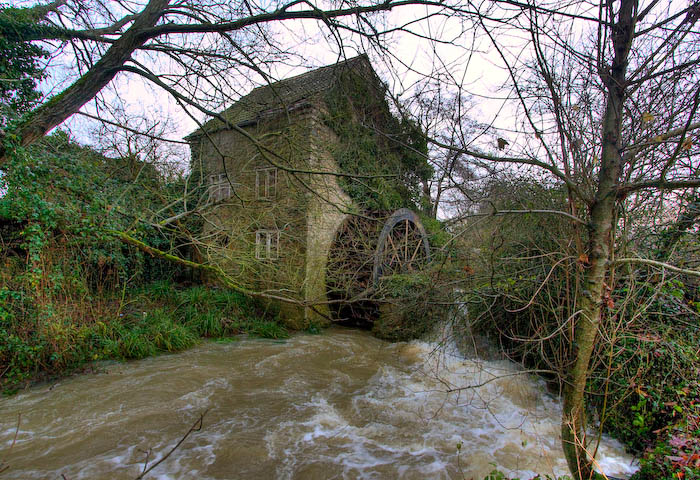
West Mill, Sherborne (courtesy of Dorset Camera)
An interesting postscript to this story, at least to me, is finding that one of John Sharrer’s nephews, who went into the business in Westbury Mills (being a silk throwster) was George Ward, a man who subsequently married George Ridout’s daughter Elizabeth on the 15th February 1768 in Sherborne. Obviously a subject which needs further investigation – my family were always of the opinion that we were concerned with silk production at some point in our past. Today I believe them.




 The Ridouts of Sherborne and Bath